Inside India’s Million-Plus Cities, the Gaps Run Deep
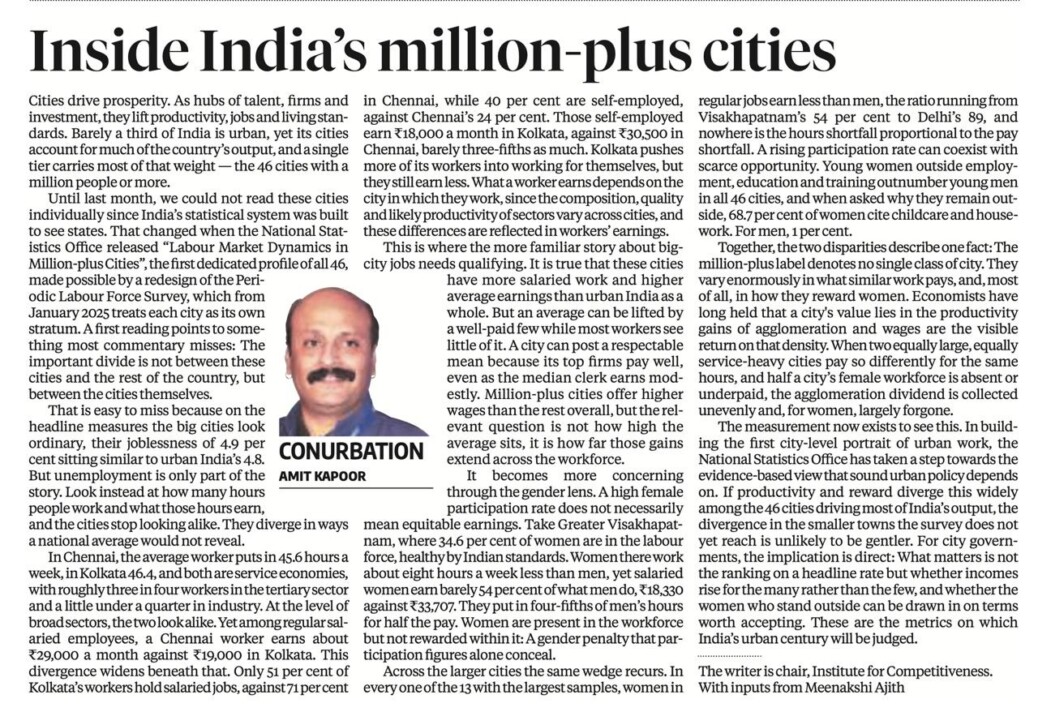
Cities are central to economic prosperity. As hubs of talent, firms and investment, they drive productivity, job creation and rising living standards. Barely a third of India is urban, yet the World Bank expects urban India to produce close to 70 per cent of national output by 2036, and a single tier carries much of that weight, the 46 cities of a million people or more. Until last month we could not read these cities one by one. India’s statistical system was built to see states, so it could report Maharashtra’s unemployment but not Mumbai’s. That changed when the National Statistics Office released Labour Market Dynamics in Million-plus Cities, the first dedicated profile of all 46, made possible by a redesign of the Periodic Labour Force Survey that from January 2025 treats each city as its own stratum. A first reading points to something most commentary on jobs data misses. The important divide is not between these cities and the rest of the country. It is between the cities themselves.
That is easy to miss because on the headline measures the big cities look ordinary, their joblessness of 4.9 per cent sitting similar to urban India’s 4.8. But unemployment is only part of the story. Look instead at how many hours people work and what those hours earn, and the cities stop looking alike. They diverge in ways a national average would not reveal.
In Chennai the average worker puts in 45.6 hours a week, in Kolkata 46.4, a difference of less than an hour, and both are overwhelmingly service economies, roughly three in four workers in the tertiary sector. On paper they are the same kind of labour market doing the same kind of work for the same length of time. Yet among regular salaried employees, the ones in stable monthly jobs, a Chennai worker earns about ₹29,000 a month against ₹19,000 in Kolkata. It has the highest tertiary share of any large city at 82 per cent and salaried pay near ₹30,700, yet an unemployment rate of 7.8 per cent, a reminder that a productive city can still leave many outside its gates. Taken together, these cities make the same case. What a worker earns turns heavily on which city they are in, more than the shape of its economy or the hours they put in would lead you to expect.
This is where the more familiar story about big-city jobs needs qualifying. It is true that these cities have more salaried work and higher average earnings than urban India as a whole. But an average can be lifted by a well-paid few while most workers see little of it. A city can post a respectable mean wage because its top firms pay well, even as the median shopkeeper or clerk earns modestly. The right question is not whether a city’s average is high, but where its workers actually sit and what most of them are paid.
It becomes more concerning when we look through the gender lens. The evidence shows that a high female participation rate does not necessarily translate to equitable earnings compared to men. Take Greater Visakhapatnam, where 34.6 per cent of women are in the labour force, a healthy figure by Indian standards. Women there work about eight hours a week less than men, yet salaried women earn barely 54 per cent of what salaried men do, ₹18,330 a month against ₹33,707. They put in roughly four-fifths of men’s hours for a little over half the pay. Presence in the workforce and reward from it have come apart.
Across the larger cities the same wedge recurs. In every one of the thirteen with the largest samples, women in regular jobs earn less than men, the ratio running from Visakhapatnam’s 54 per cent to Delhi’s 89, and nowhere is the shortfall in hours proportional to the shortfall in pay. A rising female participation rate, in other words, can coexist comfortably with scarce opportunity. Young women outside employment, education and training outnumber young men in every one of the 46 cities, and when women outside the labour force are asked why, 68.7 per cent cite childcare and housework. For men the figure is 1 per cent.
Put together, the two disparities describe the same fact. The million-plus label does not denote a single class of city. They vary enormously in what similar work pays, and most in how they reward women. Economists have long held that a city’s value lies in the productivity gains of agglomeration, the extra output firms and workers generate simply by being close together. Wages are the visible return on that density. When two equally large, equally service-heavy cities pay so differently for the same hours, and half a city’s potential female workforce is absent or underpaid, the agglomeration dividend is collected unevenly and, for women, largely forgone.
The measurement now exists to see this, which is itself the advance. In building the first city-level portrait of urban work, the National Statistics Office has taken an important step towards the granular, evidence-based view that sound urban policy depends on. If productivity and reward diverge this widely among the 46 cities that drive most of India’s output, the divergence below them, in the smaller towns the survey does not yet reach, is unlikely to be gentler. For city governments the implication is direct. What matters is not the ranking on a headline rate but whether incomes rise for the many rather than the few, and whether the women who stand outside can be drawn in on terms worth accepting. These are the metrics on which India’s urban century will be judged.
The article was published with Business Standard on July 17, 2026.