By Amit Kapoor and Sheen Zutshi
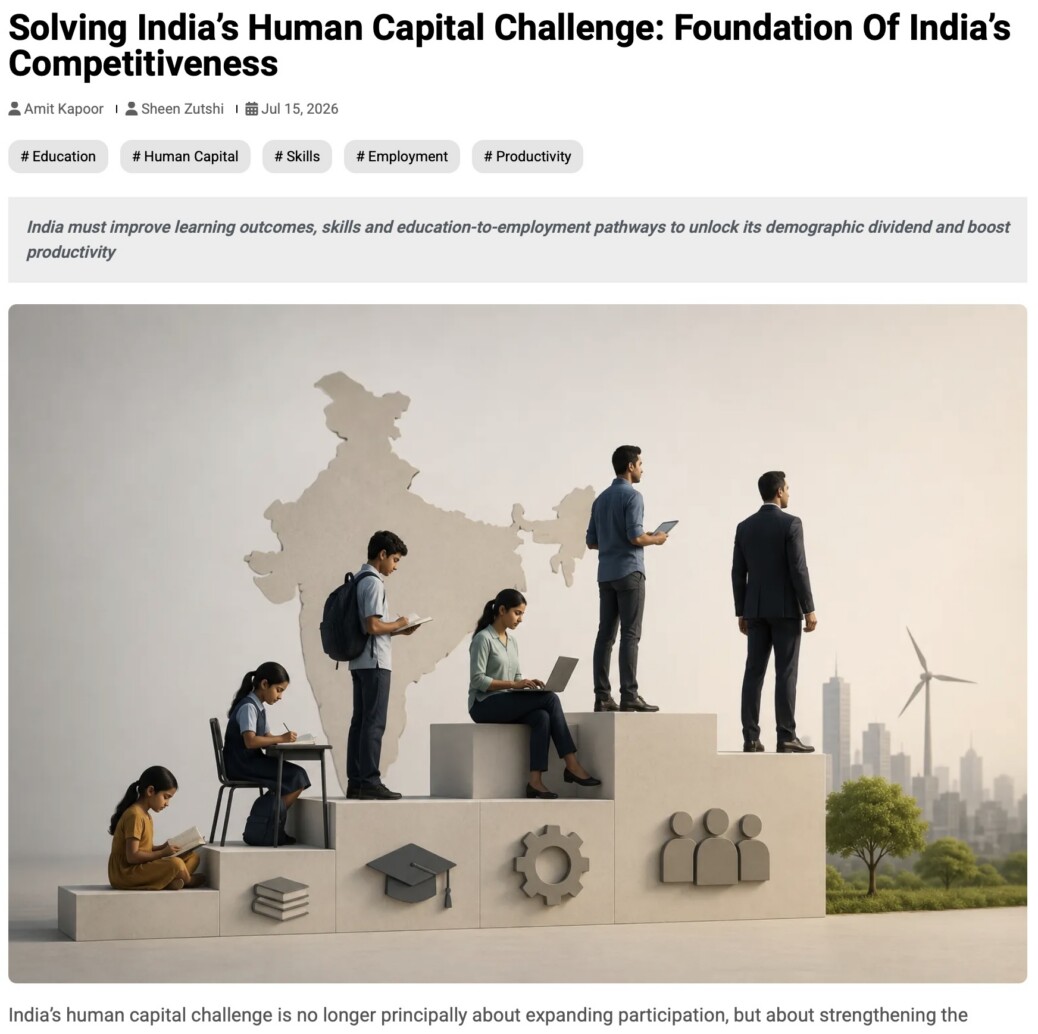
India’s human capital challenge is no longer principally about expanding participation, but about strengthening the pathways through which schooling, skilling and higher education translate into productive employment.
It is imperative for India to effectively translate its demographic dividend into workforce participation through school education, vocational training, and higher education pathways, while addressing underinvestment in education, a major factor affecting India’s productivity. The report also highlights that over the next decade, the levers of competitiveness should shift from merely providing access to schools to enhancing learning outcomes, and from a low-skilled workforce to developing highly skilled human capital.
According to the report’s UDISE+ data analysis, at the secondary level of school education, GER has increased from 66.5 per cent to 68.5 per cent, while at the middle level, GER increased from 89.5 per cent to 90.3 per cent in 2024-25. This has also been reflected in a fall in dropout rates over the last 2 years. School infrastructure across the country has significantly improved between 2018-19 and 2024-25. During this period, school electrification increased from 76.74 per cent to 93.6 per cent and 97.3 per cent; handwashing facilities increased from 59.28 per cent to 95.9 per cent; and drinking facilities increased from 95.78 per cent to 99.3 per cent.
On the frontier of digital readiness, the share of schools with access to computers has increased from 34.5 per cent to 64.7 per cent, while internet connectivity has expanded from meagre 18.73 per cent to 63.5 per cent during the same period. India’s progress in narrowing the digital divide through improved digital readiness is a significant achievement. Overall, India has improved school infrastructure for 27% of its population (ages 3-18), marking significant progress in school education. The New Education Policy 2020 enabled major reforms in school education, including overhauling India’s school education system by replacing the previous 10+2 system with a 5+3+3+4 structure, and the commencement of NIPUN Bharat, which aspires to ensure that every child acquires foundational skills by Grade 3 by the 2026-27 timeline. These achievements are commendable, but the gap remains when comparing India’s educational performance to other economies.
As per World Bank data, mean years of schooling remain at 6.88, below not only advanced economies but also middle-income peers such as Vietnam, Indonesia, Brazil, and China. Another binding challenge remains underinvestment in education. As of 2021, India’s government spending on education is 4.63% of GDP, lower than that of advanced economies such as the United States (5.42%) and Australia (5.34%), according to the World Bank.
There are also gaps in Secondary education that have remained an especially important bottleneck. Even though India has improved its GER, its pupil-to-teacher ratio (PTR) in secondary education is 23.07, higher than that of the United States (14.51) and Brazil (20.52), indicating issues with teacher training and access to appropriate schooling. According to the Economic Survey 2024-25, only 17.1% of rural schools offer secondary education, versus 38.1% in urban areas.
PARAKH, a large-scale achievement survey by NCERT that assesses learners in Grades 3, 6, and 9, shows a widening gap in students’ performance across grade levels, with learning outcomes weakening in both mathematics and language as grade level increases. At the national level, in 2025, Grade 3 averages were 64 per cent in language and 60 per cent in mathematics, but by Grade 6, they drop to 57 per cent in language and 46 per cent in mathematics, and by Grade 9, they reach 54 per cent in language and only 37 per cent in mathematics, with science and social science at about 40 per cent each. These differences in learning outcomes are masked at the national level but differ significantly at the state and district levels across gender, rural and urban areas, and social groups.
In higher education, as per AISHE data, India’s GER (18-23 years) has risen from 23.7 per cent in 2014-15 to 28.4 per cent in 2021-22. However, India needs to bridge and address the gap to reach 50 per cent by 2035. Also, India is a major producer of STEM graduates, with women accounting for 42.6 per cent, yet they hold only 14 per cent of STEM jobs. The percentage of STEM graduates declined from 34.4 per cent in 2020 to 27.82 per cent in 2023. Overall, this declining share suggests there is weaker employment absorption and a growing mismatch between India’s STEM education pipeline and labour demand.
These mismatches aren’t limited only to STEM education. According to the report Skills for the Future: Transforming India’s Workforce Landscape, there is a skill mismatch in India’s workforce, characterised by employees being placed in roles that do not align with their education levels. According to PLFS data analysis, only 8.25 per cent of the workforce with a graduate-level education is employed in occupations that match their skill level. On the other hand, more than 50 per cent of the workforce with a graduate-level education is employed in low-skilled occupations, which for around 88 per cent of India’s workforce. These roles encompass clerical work, plant operations, and comparable occupations, while only 10-12 per cent are engaged in high-competency roles. Along with this, Technical and vocational education and training (TVET) is undertaken by only 2.4 per cent of India’s workforce. India’s youth NEET rate was 24.19%, i.e., people not in education, employment, or training, being the highest among peer countries like Brazil and Vietnam, as well as developed economies such as the US.
As noted by S. Radhakrishnan, who left a profound impact on India’s education landscape, education must be a powerful instrument of social and economic transformation in the age of AI and for the dream of Viksit Bharat. Addressing the binding constraints in the education landscape is imperative, as they limit the heights of productivity India can achieve.
(Amit Kapoor is chair & Sheen Zutshi , Research Manager at Institute for Competitiveness. X: @kautiliya).
The article was published with Business world on July 15, 2026.