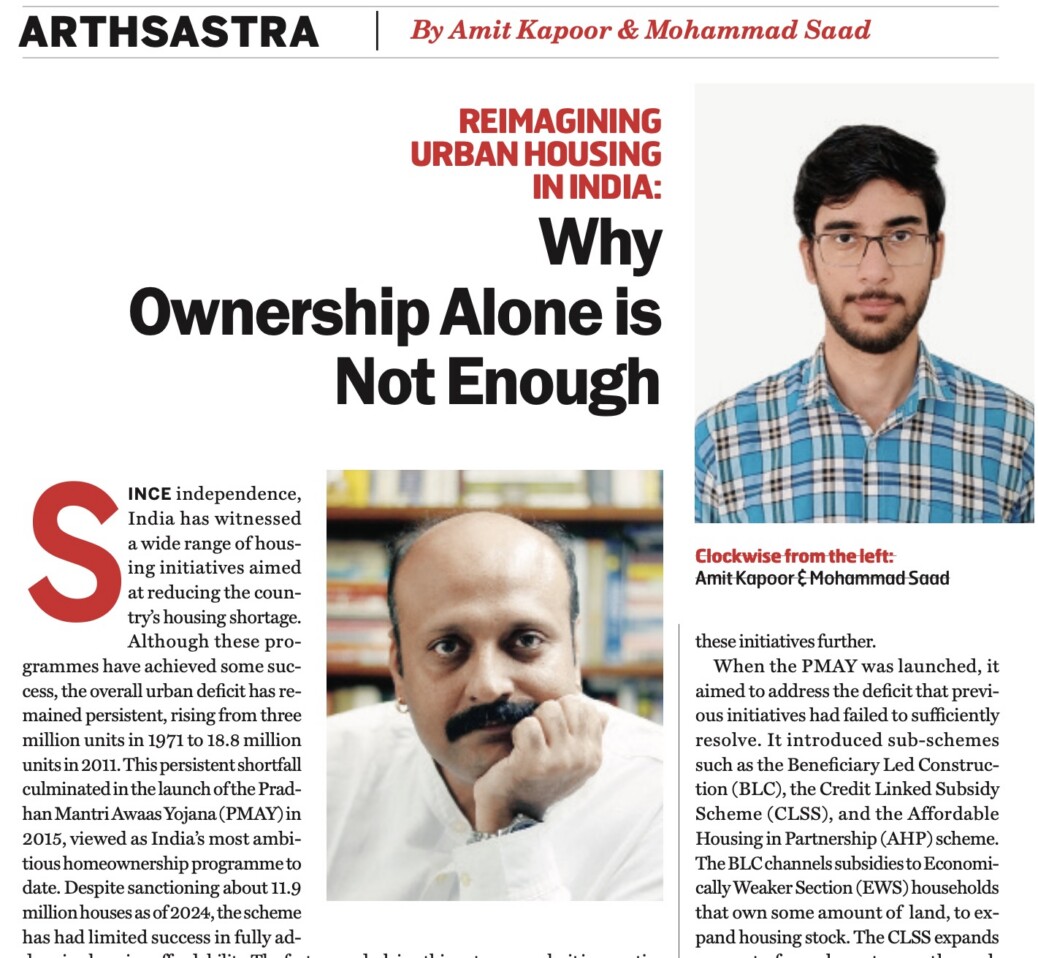
By Amit Kapoor and Mohammad Saad
Since independence, India has witnessed a wide range of housing initiatives aimed at reducing the country’s housing shortage. Although these programmes have achieved some success, the overall urban deficit has remained persistent, rising from 3 million units in 1971 to 18.8 million units in 2011. This persistent shortfall culminated in the launch of the Pradhan Mantri Awaas Yojana (PMAY) in 2015, viewed as India’s most ambitious homeownership programme to date. Despite sanctioning about 11.9 million houses as of 2024, the scheme has had limited success in fully addressing housing affordability. The factors underlying this outcome make it imperative for India to recalibrate homeownership expansion and pivot towards large-scale public rental housing for the poorest.
Housing initiatives in India are not new and have included major programmes such as the Indira Awaas Yojana (1985), the Jawaharlal Nehru National Urban Renewal Mission (2005), and the Rajiv Awaas Yojana (2011). Various supportive measures were also introduced, of which the establishment of the Housing Development Finance Corporation (1977) is a prominent example, yet the housing shortage continued to widen.
The limited success of previous initiatives is rooted in structural, financial, and administrative factors. The ideological environment within which these initiatives operated also played a considerable role. Researchers argue that India’s housing shortage is rooted in its post-independence political economy. During the 1950-60s, India prioritised capital goods over housing development, while industrial licensing and import restrictions constrained urban and industrial growth, limiting the expansion of residential housing around emerging economic centres. At the same time, previous programs have been criticized for their limited scale and coverage. Structural constraints such as inadequate land and housing finance mechanisms, unfavourable cost-benefit dynamics and poor coordination between the Centre and the states plagued these initiatives further.
When PMAY was launched, it aimed to address the deficit that previous initiatives had failed to sufficiently resolve. It introduced sub-schemes such as the Beneficiary Led Construction (BLC), the Credit Linked Subsidy Scheme (CLSS), and the Affordable Housing in Partnership (AHP) scheme. The BLC channels subsidies to EWS households that own some amount of land, to expand housing stock. The CLSS expands access to formal mortgages through interest subsidies on home loans, while AHP introduced a public private model for the construction of EWS housing.
Although PMAY has been effective in expanding homeownership, its design limits its reach among the poorest households, leaving their affordability concerns insufficiently addressed. Firstly, the number of sanctioned houses under PMAY stands at 11.9 million as of 2024, still below the last official estimate of 18.8 million in 2011. Recent estimates by NITI Aayog (2025) indicate that Indian urban centres face a housing deficit of 50 to 70 million units. Similarly, an ICRIER working paper estimates the shortage at 29 million in 2018, with over 99% concentrated among low-income households.
Analysis of the scheme has shown that it primarily benefits households with land or stable, documented incomes. Under the BLC component, lack of formal land ownership documents often leads to delays or cancellations. Rising construction costs and limited access to institutional finance further constrain beneficiaries. Similarly, the CLSS favours households with stable and verifiable income streams. Since it is implemented through banks and housing finance companies, eligibility is largely determined by commercial creditworthiness rather than housing need, thereby excluding households with informal incomes or weak credit histories. Moreover, supply side constraints have also limited the effectiveness of AHP due to design mismatches, beneficiary preferences, and financial viability constraints.
These limitations reflect structural constraints rather than a failure of PMAY’s ambition. As an ownership-based programme, PMAY has limited capacity to reach the lowest income groups, leaving a large population without adequate formal housing.
For policymakers, the priority should not be to replace or modify PMAY, but to introduce a broader housing strategy that reaches the vast number of poor households excluded from its eligibility criteria. Given the realities of India’s housing deficit, the country should consider moving towards large scale public rental housing, as it provides affordable housing access without requiring households to purchase homes beyond their means.
However, the scale of such a project entails significant costs, requiring active government involvement. Under the new housing model, rental units should be built on government owned land and leased to private developers for 50 to 60 years. Leasing the land is essential, as it removes a key supply constraint by eliminating land cost from the developer’s balance sheet. Government ownership of land also allows it to enforce rent caps and basic housing standards, including unit size and minimum facilities.
An important requirement is that developers finance construction through long tenor debt instruments, with the government ensuring that the loan tenure is co terminus with the duration of the land lease. This is crucial, as it allows developers to service debt through financing streams aligned with the roughly 70-year economic life of the housing asset. When loan tenures are shorter than asset lives, developers are less inclined to invest in housing with lower but long-term returns. With long term debt and ownership of the units, developers can use rental receipts as a steady revenue stream and as a mechanism for servicing construction debt over a sufficient time horizon. Supporting measures such as rent subsidies, low-interest construction loans, direct fiscal subsidies, and construction tax relief could also be necessary, but by removing the land component from construction costs, the model makes affordable housing significantly more feasible.
While such an ambitious project would require substantial supporting reforms, including land acquisition for rental housing, tax reforms to fund land acquisition, and a significant fiscal commitment, the larger point is to initiate a conversation on the necessary pivot in India’s housing ambitions. A series of initiatives have attempted to address the issue, and despite expanding outreach, the benefits have still not reached the most deprived. With India urbanising rapidly, it is a policy imperative that housing, as basic infrastructure, be provided adequately, or else its absence could impose adverse costs on both the social and economic conditions of the country.
(Amit Kapoor is chair & Mohammad Saad, Researcher at Institute for Competitiveness. X: @kautiliya).
The article was published with Business World on August 22, 2026.