By Amit Kapoor and Meenakshi Ajith
India’s solar transition enters its second half
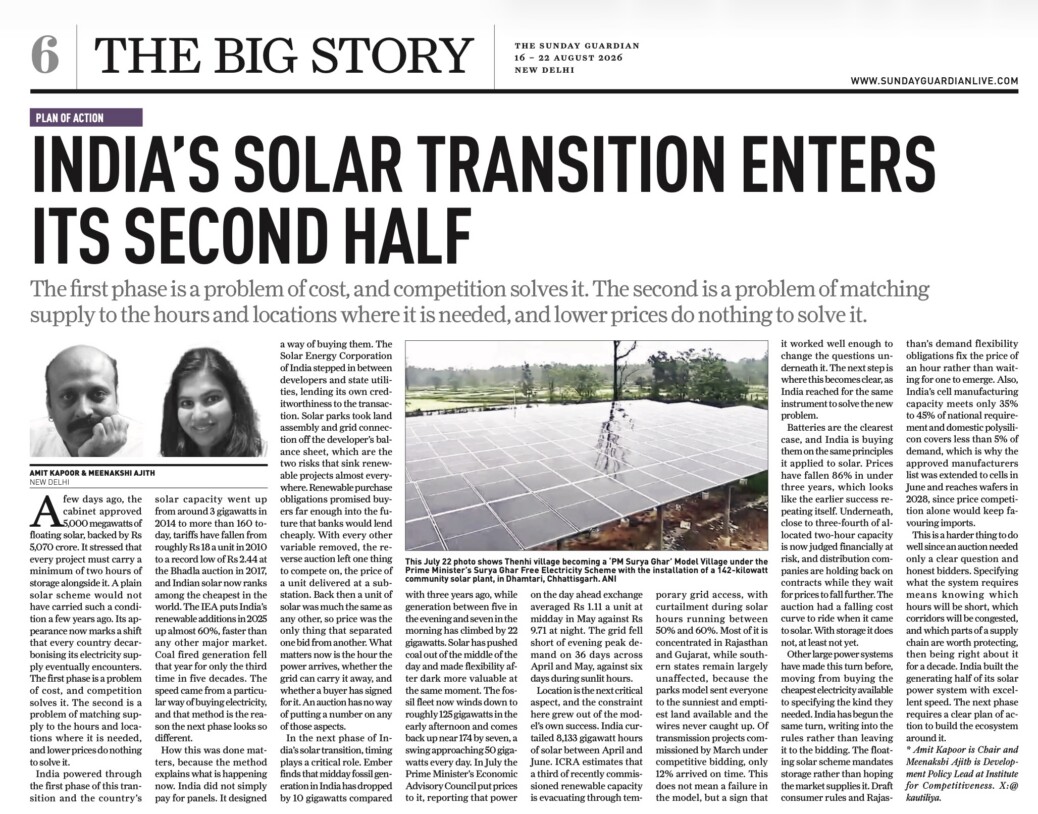
A few days ago, the cabinet approved 5,000 megawatts of floating solar, backed by ₹5,070 crore. It stressed that every project must carry a minimum of two hours of storage alongside it. A plain solar scheme would not have carried such a condition a few years ago. Its appearance now marks a shift that every country decarbonising its electricity supply eventually encounters. The first phase is a problem of cost, and competition solves it. The second is a problem of matching supply to the hours and locations where it is needed, and lower prices do nothing to solve it.
India powered through the first phase of this transition and the country’s solar capacity went up from around 3 gigawatts in 2014 to more than 160 today, tariffs have fallen from roughly ₹18 a unit in 2010 to a record low of ₹2.44 at the Bhadla auction in 2017, and Indian solar now ranks among the cheapest in the world. The IEA puts India’s renewable additions in 2025 up almost 60 per cent, faster than any other major market. Coal fired generation fell that year for only the third time in five decades. The speed came from a particular way of buying electricity, and that method is the reason the next phase looks so different.
How this was done matters, because the method explains what is happening now. India did not simply pay for panels. It designed a way of buying them. The Solar Energy Corporation of India stepped in between developers and state utilities, lending its own creditworthiness to the transaction. Solar parks took land assembly and grid connection off the developer’s balance sheet, which are the two risks that sink renewable projects almost everywhere. Renewable purchase obligations promised buyers far enough into the future that banks would lend cheaply. With every other variable removed, the reverse auction left one thing to compete on, the price of a unit delivered at a substation. Back then a unit of solar was much the same as any other, so price was the only thing that separated one bid from another. What matters now is the hour the power arrives, whether the grid can carry it away, and whether a buyer has signed for it. An auction has no way of putting a number on any of those aspects.
In the next phase of India’s solar transition, timing plays a critical role. Ember finds that midday fossil generation in India has dropped by 10 gigawatts compared with three years ago, while generation between five in the evening and seven in the morning has climbed by 22 gigawatts. Solar has pushed coal out of the middle of the day and made flexibility after dark more valuable at the same moment. The fossil fleet now winds down to roughly 125 gigawatts in the early afternoon and comes back up near 174 by seven, a swing approaching 50 gigawatts every day. In July the Prime Minister’s Economic Advisory Council put prices to it, reporting that power on the day ahead exchange averaged ₹1.11 a unit at midday in May against ₹9.71 at night. The grid fell short of evening peak demand on 36 days across April and May, against six days during sunlit hours.
Location is the next critical aspect, and the constraint here grew out of the model’s own success. India curtailed 8,133 gigawatt hours of solar between April and June. ICRA estimates that a third of recently commissioned renewable capacity is evacuating through temporary grid access, with curtailment during solar hours running between 50 and 60 per cent. Most of it is concentrated in Rajasthan and Gujarat, while southern states remain largely unaffected, because the parks model sent everyone to the sunniest and emptiest land available and the wires never caught up. Of transmission projects commissioned by March under competitive bidding, only 12 per cent arrived on time. This does not mean a failure in the model, but a sign that it worked well enough to change the questions underneath it. The next step is where this becomes clear, as India reached for the same instrument to solve the new problem.
Batteries are the clearest case, and India is buying them on the same principles it applied to solar. Prices have fallen 86 per cent in under three years, which looks like the earlier success repeating itself. Underneath, close to three-fourth of allocated two-hour capacity is now judged financially at risk, and distribution companies are holding back on contracts while they wait for prices to fall further. The auction had a falling cost curve to ride when it came to solar. With storage it does not, at least not yet.
Other large power systems have made this turn before, moving from buying the cheapest electricity available to specifying the kind they needed. India has begun the same turn, writing into the rules rather than leaving it to the bidding. The floating solar scheme mandates storage rather than hoping the market supplies it. Draft consumer rules and Rajasthan’s demand flexibility obligations fix the price of an hour rather than waiting for one to emerge. Also, India’s cell manufacturing capacity meets only 35 to 45 per cent of national requirement and domestic polysilicon covers less than 5 per cent of demand, which is why the approved manufacturers list was extended to cells in June and reaches wafers in 2028, since price competition alone would keep favouring imports.
This is a harder thing to do well since an auction needed only a clear question and honest bidders. Specifying what the system requires means knowing which hours will be short, which corridors will be congested, and which parts of a supply chain are worth protecting, then being right about it for a decade. India built the generating half of its solar power system with excellent speed. The next phase requires a clear plan of action to build the ecosystem around it.
(Amit Kapoor is Chair and Meenakshi Ajith is Development Policy Lead at Institute for Competitiveness.)
The article was published with The Sunday Guardian on August 16, 2026.