By Amit Kapoor and Atul Tiwari
Every country reaches a moment when its development can no longer be defined solely by repairing inherited deficits. It must also be defined by the capabilities it chooses to build for the future. For India, this is precisely that moment as it pursues its journey towards a vision of a developed economy by 2047. With a working-age population of around 65% of its total population, the country needs to focus not merely on its technology, infrastructure, and the social sector, but on ensuring these investments reach the most decisive aspect of all: its people.
There is a simultaneous disruption in the competencies required for the labour market due to AI and evolving frontier intelligence. Therefore, India’s journey would depend on strengthening its current human capital and preparing its people for the future of work.
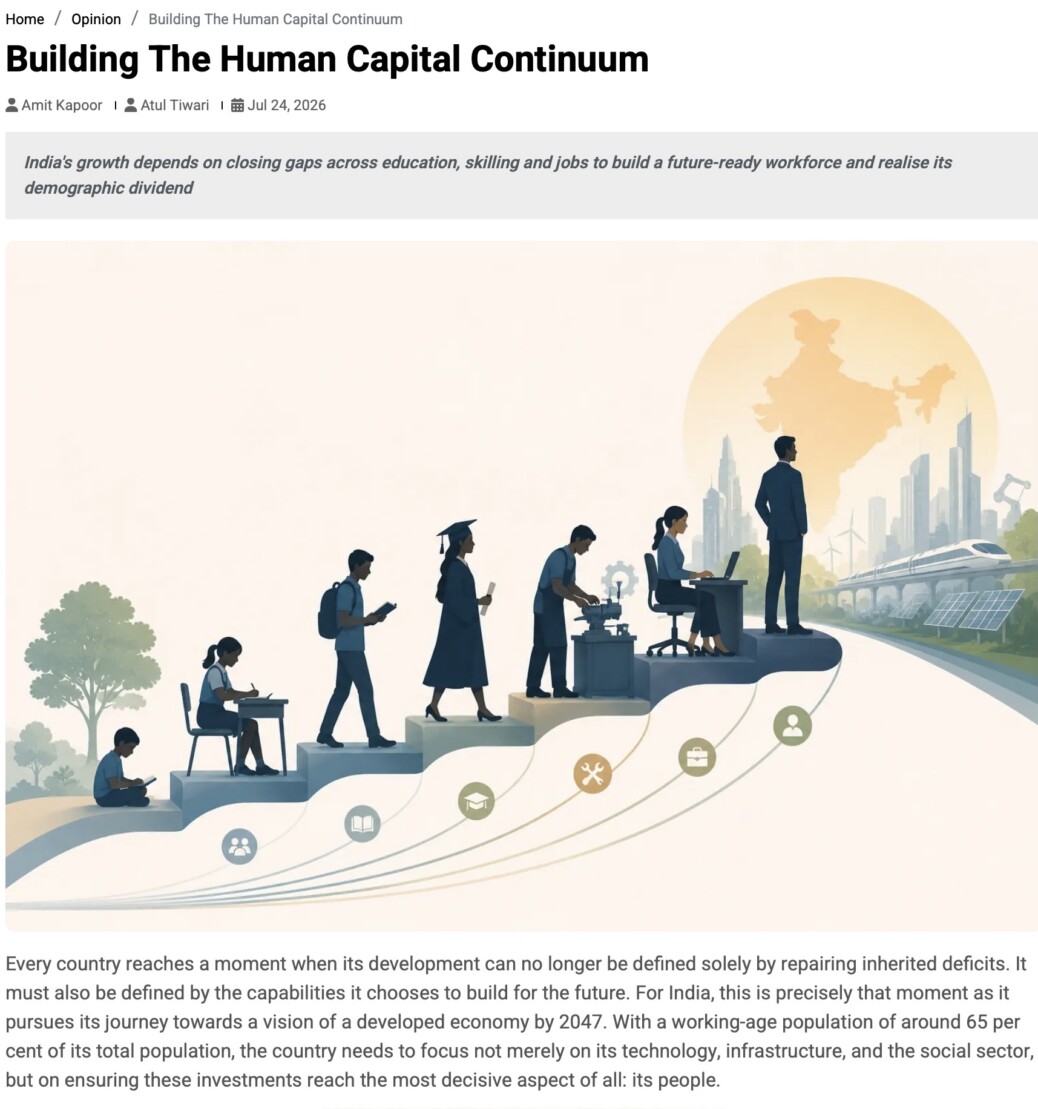
India’s human capital challenge is often described from the perspective of the labour market, be it employability, skilling, automation, and now artificial intelligence, which are creating pressures for a country trying to catch up. But the labour market is where the symptoms appear; the real challenge is a human capital continuum challenge, which spans from early childhood development and foundational learning to higher education, vocational training, work experience, and lifelong adaptability.
Nobel laureate economist James Heckman’s work on human capital formation offers a useful way to understand this continuum. His central insight is that “skills beget skills, the foundational capabilities acquired early in life make later learning, training and adaptation more productive. This also means that the deficits left unresolved at one stage are carried forward into the next, making the labour market challenge appear sudden when, in fact, the deficits have been accumulating for years. This distinction is important because India’s challenge is not the absence of progress, but the uneven transmission of progress across the human capital continuum.
India’s current challenge is the uneven conversion of progress across the education-skilling-work continuum. India has expanded, with improvements over the last decades in access to education and school infrastructure, with a focus on digital; its higher education institutes have also increased to 70,018 from 51,534 in 2014-15, with more than 44.6 million students enrolled; India has one of the world’s largest higher education ecosystems, which also shapes the global supply of skilled potential workforce. However, leakages remain; inclusive access to digital infrastructure needs to improve, and the transition from secondary to higher secondary stands at 75.1 per cent as per UDISE 2024-25, indicating that nearly one in four students do not progress to the next stage. This may be attributed to their learning outcomes. As PARAKH 2024 shows, learning outcomes decline as students progress through the grades: language scores fall from 67 per cent in Grade 3 to 54 per cent in Grade 9, while mathematics scores fall from 60 to 37 per cent. These gaps matter because higher education and skilling ecosystems inherit this earlier base, with weak foundational learning, raising the cost of later correction.
The next leakage lies between education and formal skill formation. PLFS data show that only 4.1 per cent of the workforce has received formal vocational training, even though PMKVY, an MSDE skilling initiative, has supported training for over 1.6 crore candidates and is now focusing on ITI modernisation, industry partnerships, and promoting apprenticeships and a dual training system. Moreover, higher education faces a related challenge; GER has risen to 28.4 per cent but remains below the NEP 2020 target of 50 per cent. These gaps are reflected in the labour market, as the Institute for Competitiveness “Skills for the Future” report shows that only 8.25 per cent of graduates are in roles aligned with their qualification level. Therefore, the leakage of the continuum is the weak conversion from one stage to the next: from access to learning, progression to formal training and skilling, to labour market outcomes. These leakages matter and vary across geographies, as they differ in demography, foundational outcomes, skilling access, industrial base, and labour demand, making the binding constraints of the continuum vary across states.
This also necessitates that India’s evidence architecture evolve, simply because current datasets tell a domain-specific story rather than a continuum story. Currently, India doesn’t have a fully linked system or studies conducted that follow individuals from early learning to skill formation to employment. There is one important initiative, APAAR ID, through “the one nation, one student ID” initiative, which is a step towards a portable academic identity that can carry records, credits and credentials across institutions. Until such systems mature, state-level human capital diagnostics can still identify where the state appears weakest and where policy must focus.
The economies cited as human capital success stories, such as Germany, South Korea, and Singapore, did not transform their workforces by perfecting a single stage of the continuum. Instead, they strengthened connections across education, TVET, employer participation, and lifelong learning. India does not need to imitate any single model. Its scale, diversity, and heterogeneity require a distinct approach. This also requires recognising that human capital becomes productive only when the stages of the continuum reinforce one another.
The real task for Viksit Bharat is not to produce more students, graduates, or a more skilled workforce to improve employability and keep pace with the future. It is to ensure that health, learning, and skills translate into productive livelihoods across states and that its demographic dividend is not secured by population size alone. It should be secured by capability, absorption, and closing the leakages across the human capital continuum.
(Amit Kapoor is chair, Institute for Competitiveness and Atul Tiwari is Former Secretary, Ministry of Skill Development and Entrepreneurship, Government of India , X: @kautiliya)
The article was published with Business World on July 27, 2026.