India’s urban income story is, by many conventional measures, a notable one. Between 2017–18 and 2023–24, urban incomes grew faster than rural ones at every point in the distribution. Cities absorbed workers, generated formal employment, and created a consuming middle class that is now the centrepiece of most bullish accounts of India’s economic trajectory. While these are remarkable achievements, the question worth asking is not whether cities are growing but what kind of growth this is, who it is reaching, and what it is leaving behind in the process. India’s urban transformation is real and measurable, but its full significance can only be understood when the aggregate numbers are looked at more closely.
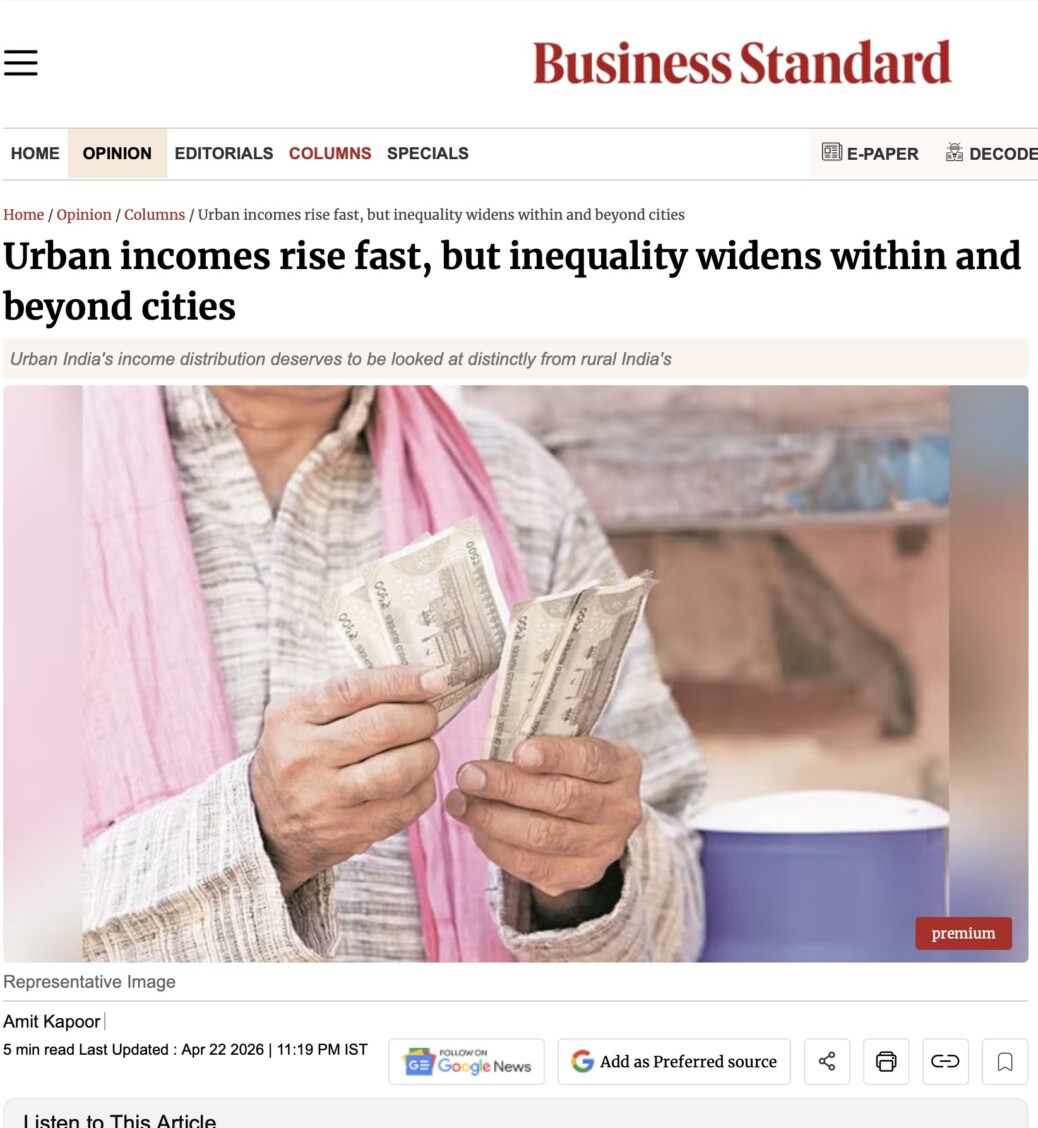
Urban India’s income distribution deserves to be looked at distinctly from rural India’s. Urban incomes are significantly higher across all thresholds, and the distance is widening. According to the Institute for Competitiveness’ 2025 report on Income Inequality and Labour Markets in India, in 2023–24 the top 10% urban income threshold of ₹44,000 was more than double the rural equivalent of ₹21,500. The top 1% urban threshold of ₹90,000 was 80% higher than its rural counterpart, up from 68% in 2017–18. At the bottom, the urban floor of ₹6,000 was double the rural ₹3,000, a figure that remained flat in nominal terms over seven years. While the urban floor has been rising, the rural floor has largely held still. This is not a reason to temper the urban story but an indication of where the next chapter of growth needs to reach and less a verdict on what cities have done than a measure of how much further the gains can travel.
It is worth noting that economic disparities are arising within cities themselves. The urban bottom 50% grew at a CAGR of nearly 7% between 2017–18 and 2023–24, against 5% for rural areas, and the urban bottom 10% at 5.93% against zero rural growth. Yet within cities, gains were uneven: the ratio of top 1% earnings to the median rose from 5.89 to 6.25 times over the same period. At the state level, rural-urban gaps widened most sharply in Himachal Pradesh, Bihar, Goa, and Meghalaya, particularly among top income groups. Across most of India, cities are capturing income growth at every level of the distribution while rural areas fall progressively further behind. This raises an important question: what determines whether a city’s growth reaches its residents broadly or concentrates among a few?
Urban economists have long noted that public infrastructure is a consequential driver of whether growth is broadly shared, and when it is uneven, so is access to the labour market. India’s municipal budgets have grown substantially over the past decade, yet spending tends to favour visible, high-profile projects like metro lines and smart city initiatives over the quieter work of maintaining systems residents depend on daily: water supply, sewage, public transport, neighbourhood roads. Where the gap between what municipal systems are designed to deliver and what they actually provide grows wide, it is often filled by informal arrangements that serve people adequately in the short term but leave room for more equitable solutions. Closing that gap is as much an opportunity as a challenge, and one that cities with growing budgets are well placed to act on.
The infrastructural gaps that affect the standard of living get further accentuated by the problem of urban unemployment. The latest PLFS data from March 2026 puts urban unemployment at 6.8%, considerably higher than its rural counterpart. The city that offers higher wages to those in work also presents a more uncertain path to finding that work, pointing to a labour market where entry into the formal tier remains an aspiration for many. Addressing this well is one of the more important things cities can do to make growth more inclusive. Women face a particular version of this challenge. Urban female unemployment stood at 9.0% in March 2026, against 6.1% for urban men, a gap that points to structural barriers to entry as much as to the overall availability of jobs. According to the PLFS Annual Report 2025, urban female labour force participation stood at just 27.7%, against 76.2% for urban men; a distance that points equally to the social and structural constraints shaping women’s engagement with the urban economy.
The picture that emerges is of a city in impressive transformation, with important work still ahead. Urban income growth has lifted millions and demonstrated India’s capacity to move indicators at scale and speed. The distributional questions of who is sharing in those gains, at what pace, and through what quality of work are not critiques of that achievement but extensions of it. This means ensuring gains travel further to the rural bottom and that within cities, they reach those on the margins. India has the capacity and momentum to act. The question is whether the opportunity is seized to build a shared urban prosperity.
The article was published with Business Standard on April 22, 2026.