By Amit Kapoor and Kartik
The oldest constraint in economics is not capital or labor but the limits of human ingenuity in deploying them. To grow productivity is to push against that constraint, to make the same land, labor, and capital yield more than they did before. For a developing economy like India, whose convergence with the productivity frontier remains incomplete, this is not merely an academic observation but a strataegic imperative. The growth model must pivot away from factor accumulation and toward the continuous discovery of better methods, superior techniques, and smarter allocations of finite resources. A thriving innovation ecosystem does not emerge spontaneously. It is built on interlocking foundations of high-quality human capital, an enabling regulatory environment, and a business climate that rewards risk. At the intersection of all three sits the startup, the organism through which innovative ambition crosses the difficult threshold from idea to economic reality.
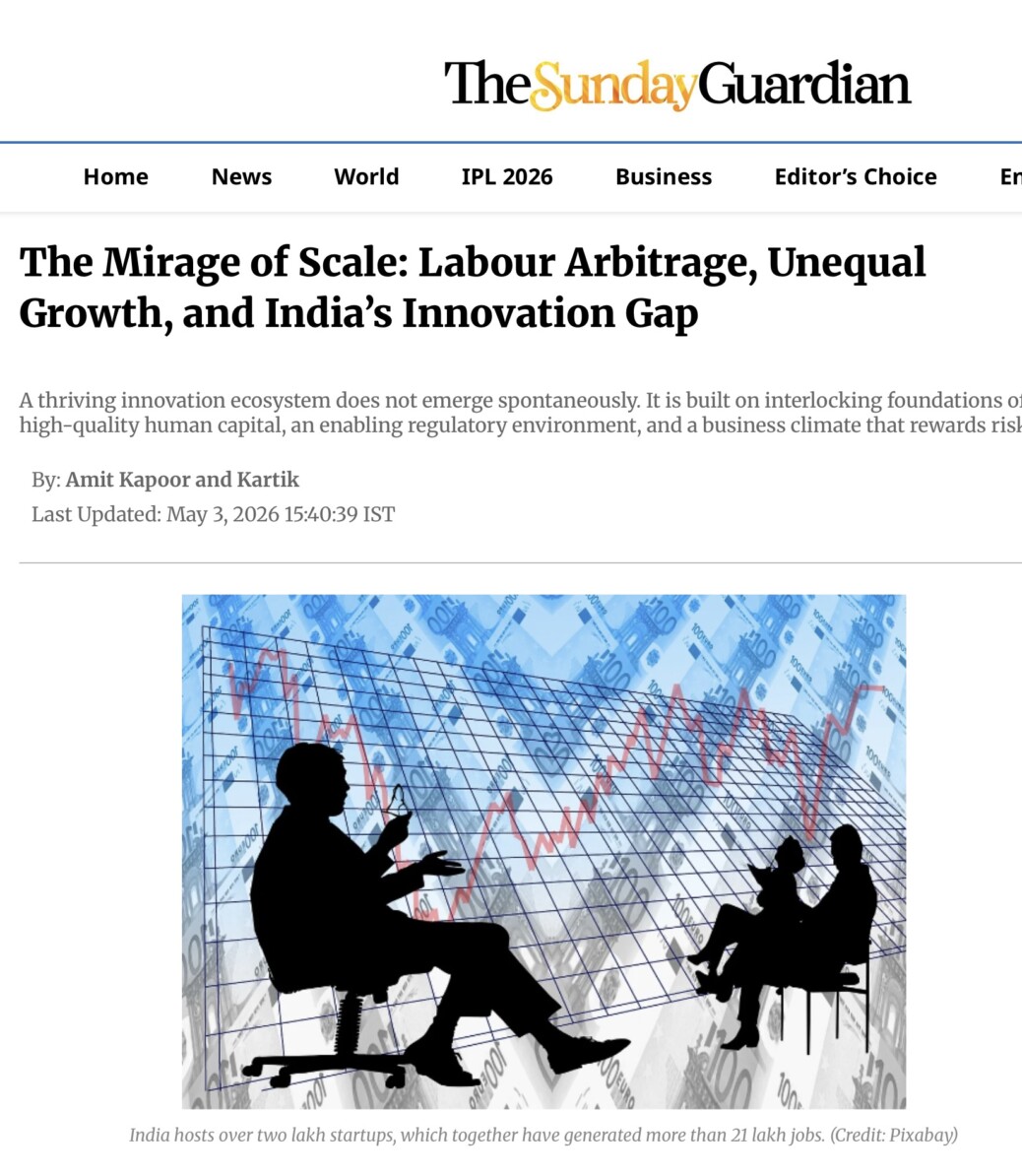
India’s record since the launch of the Startup India mission in 2016 appears remarkable by that measure. The country now hosts over two lakh startups, which together have generated more than 21 lakh jobs. Yet these aggregates have a way of flattering. Strip away the headline numbers, and a more complicated picture emerges: startups concentrated in a handful of cities, scale remaining elusive for the vast majority, and structural bottlenecks that policy enthusiasm alone has not dissolved. The central question is whether India’s startup ecosystem is structurally competitive or if its growth conceals fault lines that will shape its future.
The impressive growth of startups in the country can be attributed to the host of actions taken by DPIIT to assist the creation and scaling of startups. Recognition by the DPIIT leads to exemptions such as a 3-year tax exemption on profits, an 80% IPR rebate on trademark and patent filings, and Angel Tax Exemptions. On the financing front, the government has set up the Fund of Funds for Startups (FFS) & Startup India Seed Fund Scheme (SISFS), investing close to ₹26,445 Cr, ensuring availability of funds for startups at every stage of their development. Additionally, integrating startups into the Government E Marketplace provides a reliable customer, with 29,000 startups listed on GEM. Regulatory relief has been significant, with startups benefiting from the removal of about 47,000 compliance requirements, easing business formation.
Yet despite the enabling policy infrastructure, the startup ecosystem in the country shows various concerns. First, there is the lack of scaling up of startups in the Indian economy. According to the Startup India Portal, 37.19% of startups in India are at the ideation stage, whereas 28.99% are at the validation stage, highlighting a key scale-up gap among Indian startups. The second issue with the startup ecosystem is the skewed distribution of startups across the country. Only five out of the 36 Indian states, namely Uttar Pradesh, Delhi, Gujarat, Maharashtra and Karnataka, account for more than 55% of the DPIIT-recognised startups. The trend is further mirrored in company registrations, with more than 54% of newly registered companies incubated in Maharashtra and Karnataka. The intellectual property landscape shows a similar concentration, of the 67,822 patents filed in the country in the year 2024-25, nearly 46% were filed in the three states of Tamil Nadu, Maharashtra and Karnataka alone. These structural concerns of lack of scaling, geographic concentration of entrepreneurship and patent activity point to deeper systematic challenges warranting a closer examination.
The three systemic challenges above can be attributed to a shared structured reality in the Indian ecosystem, i.e., the high concentration of human capital and venture capital in only a few states. Of the 36 Indian states, only 17 have more than 10% of their workforce in Skill 4 occupations (the highest skill set), with Maharashtra at 15% and Tamil Nadu at 12.4%. In addition, of the 36 states in India, at least 12 have a STEM Workforce of less than 2% of their total workforce, highlighting deficiencies in the country’s human capital base. At the same time, on venture capital depth, India records only 1.44 late-stage VC deals per billion PPP GDP and ranks at 63rd, far below other advanced economies, leaving high-potential firms deprived of the capital needed to grow beyond their early stages.
Faced with these constraints, India’s most successful startups have found their most reliable path to scale not in innovation, but in labour arbitrage. Indian startups such as Zomato, Zepto, and Urban Clap have based their success on utilising cheap labour readily available in the Indian context and benefiting from the country’s social asymmetry. This stands in contrast to the idea of creative destruction, the core idea that innovative technologies and methods continuously replace obsolete ones, making way for better methods and ultimately driving economic growth. For example, Tesla disrupted the IC engine-based automobile industry, Netflix disrupted the entire DVD and rental industry & Amazon disrupted the traditional retail industry. The movement away from creative destruction in India is heavily influenced by the skill shortage experienced across the country, influencing the startups to build business models on something abundant, i.e. cheap and unskilled labour, and thus building a startup ecosystem growing in only numbers but lacking the structural strength to drive productivity gains and technological disruption that India’s developmental ambitions demand.
For India to build a truly competitive startup ecosystem, its dependence on labour arbitrage needs to be completely dismantled and replaced with a model rooted in innovation and creative destruction. To enable this, significant efforts are needed to bridge the stark disparities in the availability of a skilled workforce, STEM penetration, and access to high-quality foreign capital. Only when high-quality human talent and adequate capital are available across the length and breadth of the country will Indian startups have the foundational conditions needed to innovate and compete in the global startup environment. The ambition for India’s startup ecosystem must therefore be not one of numbers alone, but of depth, competitiveness, and the capacity to drive the kind of innovation that moves the entire economy forward.
(Amit Kapoor is chair & Kartik is Senior Researcher at Institute for Competitiveness. X: @kautiliya).
The article was published with The Sunday Guardian on May 3, 2026.