By Amit Kapoor, Richard Dasher and Inputs from Meenakshi Ajith
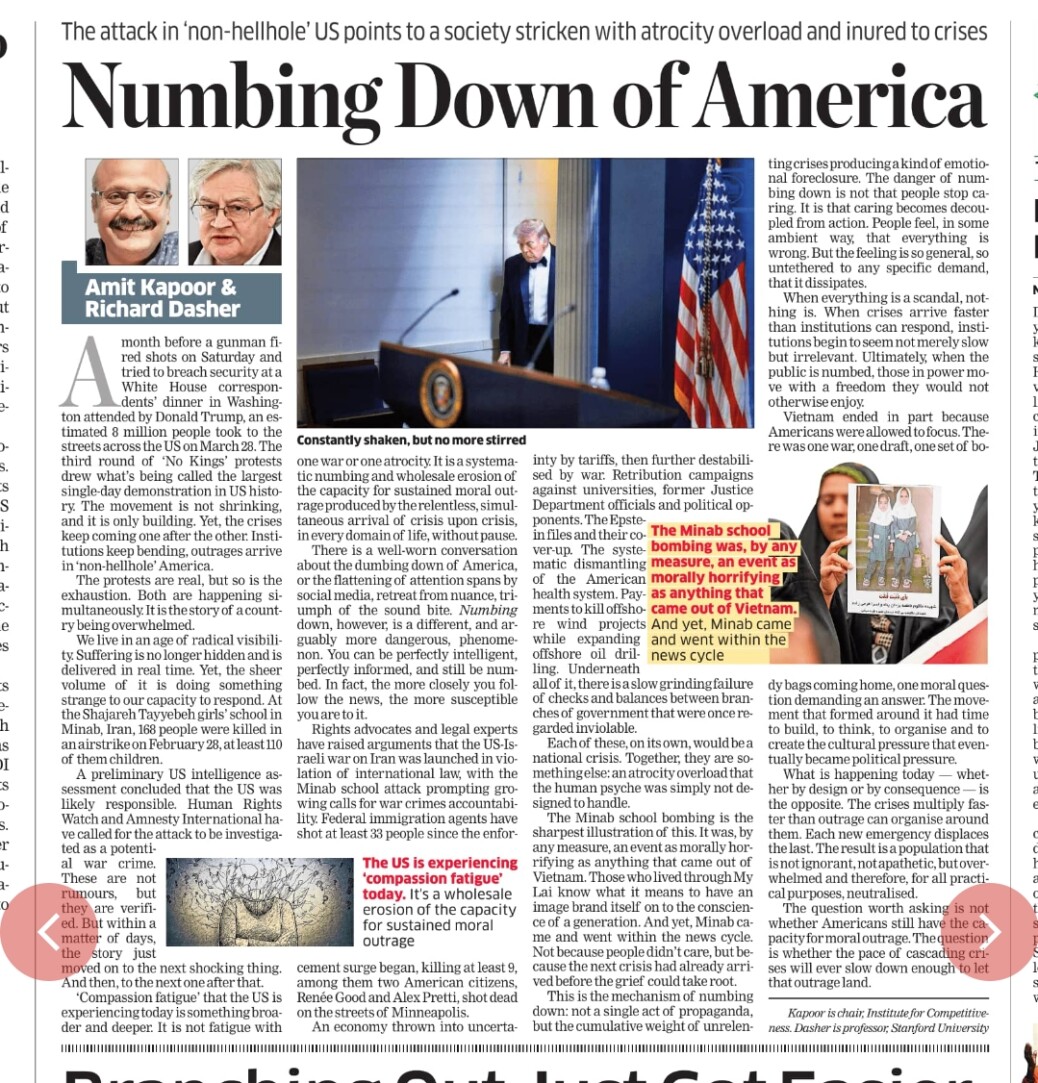
A month before a gunman fired shots on Saturday and tried to breach security at a White House correspondents’ dinner in Washington attended by Donald Trump, an estimated 8 million people took to the streets across the US on March 28. The third round of ‘No Kings’ protests drew what’s being called the largest single-day demonstration in US history. The movement is not shrinking, and it is only building. Yet, the crises keep coming one after the other. Institutions keep bending, outrages arrive in ‘non-hellhole’ America
The protests are real, but so is the exhaustion. Both are happening simultaneously. It is the story of a country being overwhelmed.
We live in an age of radical visibility. Suffering is no longer hidden and is delivered in real time. Yet, the sheer volume of it is doing something strange to our capacity to respond. At the Shajareh Tayyebeh girls’ school in Minab, Iran, 168 people were killed in an airstrike on February 28, at least 110 of them children.
A preliminary US intelligence assessment concluded that the US was likely responsible. Human Rights Watch and Amnesty International have called for the attack to be investigated as a potential war crime. These are not rumours, but they are verified. But within a matter of days, the story just moved on to the next shocking thing. And then, to the next one after that.
‘Compassion fatigue’ that the US is experiencing today is something broader and deeper. It is not fatigue with one war or one atrocity. It is a systematic numbing and wholesale erosion of the capacity for sustained moral outrage produced by the relentless, simultaneous arrival of crisis upon crisis, in every domain of life, without pause.
There is a well-worn conversation about the dumbing down of America, or the flattening of attention spans by social media, retreat from nuance, triumph of the sound bite. Numbing down, however, is a different, and arguably more dangerous, phenomenon. You can be perfectly intelligent, perfectly informed, and still be numbed. In fact, the more closely you follow the news, the more susceptible you are to it.
Rights advocates and legal experts have raised arguments that the US-Israeli war on Iran was launched in violation of international law, with the Minab school attack prompting growing calls for war crimes accountability. Federal immigration agents have shot at least 33 people since the enforcement surge began, killing at least 9, among them two American citizens, Renee Good and Alex Pretti, shot dead on the streets of Minneapolis.
An economy thrown into uncertainty by tariffs, then further destabilised by war. Retribution campaigns against universities, former Justice Department officials and political opponents. The Epstein files and their cover-up. The systematic dismantling of the American health system. Payments to kill offshore wind projects while expanding offshore oil drilling. Underneath all of it, there is a slow grinding failure of checks and balances between branches of government that were once regarded inviolable.
Each of these, on its own, would be a national crisis. Together, they are something else: an atrocity overload that the human psyche was simply not designed to handle.
The Minab school bombing is the sharpest illustration of this. It was, by any measure, an event as morally horrifying as anything that came out of Vietnam. Those who lived through My Lai know what it means to have an image brand itself on to the conscience of a generation. And yet, Minab came and went within the news cycle. Not because people didn’t care, but because the next crisis had already arrived before the grief could take root.
This is the mechanism of numbing down: not a single act of propaganda, but the cumulative weight of unrelenting crises producing a kind of emotional foreclosure. The danger of numbing down is not that people stop caring. It is that caring becomes decoupled from action. People feel, in some ambient way, that everything is wrong. But the feeling is so general, so untethered to any specific demand, that it dissipates.
When everything is a scandal, nothing is. When crises arrive faster than institutions can respond, institutions begin to seem not merely slow but irrelevant. Ultimately, when the public is numbed, those in power move with a freedom they would not otherwise enjoy.
Vietnam ended in part because Americans were allowed to focus. There was one war, one draft, one set of body bags coming home, one moral question demanding an answer. The movement that formed around it had time to build, to think, to organise and to create the cultural pressure that eventually became political pressure.
What is happening today – whether by design or by consequence – is the opposite. The crises multiply faster than outrage can organise around them. Each new emergency displaces the last. The result is a population that is not ignorant, not apathetic, but overwhelmed and therefore, for all practical purposes, neutralised.
The question worth asking is not whether Americans still have the capacity for moral outrage. The question is whether the pace of cascading crises will ever slow down enough to let that outrage land.
The article was published with Economic Times on April 27, 2026.