By Amit Kapoor and Sheen Zutshi
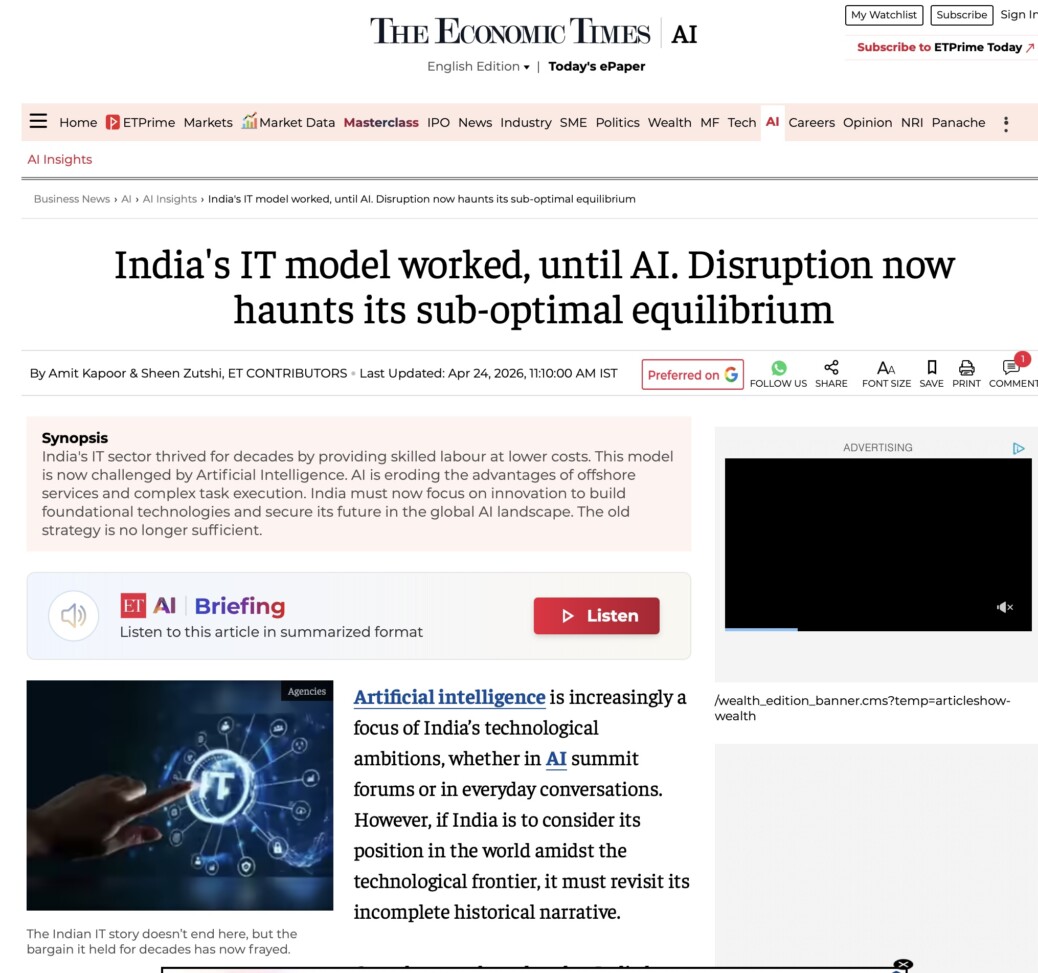
Artificial intelligence is increasingly a focus of India’s technological ambitions, whether in AI summit forums or in everyday conversations. However, if India is to consider its position in the world amidst the technological frontier, it must revisit its incomplete historical narrative.
Over the past three decades, India has showcased pride in its story in the technological landscape through its information technology (IT) sector, a narrative that developed after its 1991 liberalisation reforms. The strategy was simple: firms in the United States and other developed nations shaped the architecture; India provided labour at a lower cost and gradually invested in controlling intellectual property, turning global opportunities into domestic realisations, thus becoming a reliable participant in global value chains.
As a result, Infosys, TCS, and Wipro became household and global names, highlighting India’s competence; millions entered the software services sector; and Bengaluru gradually gained recognition as the “Silicon Valley of India”. This approach has proven successful over decades; by 2023-24, the sector employs around 5.43 million people and contributes approximately 7 per cent to India’s GDP. The sector’s total revenue grew from $118 billion to an estimated $238 billion between fiscal years 2014-15 and 2024-25. Export revenue also increased from $100 billion to $224 billion over the same period.
India did not primarily pioneer new technologies in Bengaluru as Silicon Valley did, or as China’s leading innovation hubs have. Instead, it became an essential executor of the global IT system, where the foundations of new technologies were laid in advanced economies. The outcome of this approach enabled Indian firms to maximise service through scalable services, and investment poured from the West into execution-oriented technical skills for engineering talent. Eventually, states such as Karnataka and Tamil Nadu, home to cities such as Bengaluru and Chennai, which currently drive more than 50 per cent of IT/service exports, started benefiting from export growth and foreign exchange inflows, and India remained a globally credible and reliable service sector. Inherently, this led to the emergence of a stable but collectively limiting equilibrium and moving beyond it required moving beyond coordination. It produced a system biased towards low-risk execution rather than bearing the high risks required to advance technological landscapes and therefore did not undertake a deeper structural transformation.
The Indian IT-model equilibrium relied on a three-part bargain: labour-cost arbitrage, the non-automatability of complex work, and organisational preferences in developed countries for outsourced humans over software-based substitution. This equilibrium is now under pressure, with Artificial Intelligence emerging as a disruption, changing the existing landscape, eroding the layer on which the IT model depended, and exposing the limits of the old equilibrium while destabilising the conditions that sustained it.
This is especially true in the context of India, as AI is destabilising all three, but not equally. The Anthropic Economic Index report already shows India as the second-largest market for Claude AI users. The report revealed that in India, 45.2 per cent of Claude usage is tied to computer and mathematical tasks, and five of the top 10 use cases fall under the software and web development. India has scaled the success of its IT model through labour arbitrage, but now AI is squeezing it, causing the old model’s equilibrium to falter. As generative AI expands into more cognitive and white-collar tasks, it erodes the stability of the old equilibrium in India, reducing the labour-cost advantages of offshore delivery, weakening protections against task complexity, and shifting client preferences worldwide towards automation.The limits of the old model become harder to evade when we compare India’s innovative hubs with those of other countries,such as the United States and China.
As per WIPO’s GII cluster rankings, among the top 100 innovative clusters, India has only 4, while China has 24 and the United States has 22. Bengaluru is a leading cluster in India, with 336 PCT applications, 1,105 scientific articles, and 193 venture capital deals per million inhabitants, and ranks 83rd globally in innovation cluster intensity. Whereas San Jose – San Francisco records 8,132 PCT applications, 9,044 scientific articles and 2,608 VC deals; Shenzhen-Hong Kong-Guangzhou records 2,292 PCT applications and 3,775 scientific articles and ranks first globally in the Innovation cluster. These statistics reveal India’s position in the global innovation hierarchy and demonstrate that this model was not truly innovative. The model was based on a bargain with time, focusing on short- and medium-term gains for firms through scalable services and for the state government via foreign inflows and export growth, while postponing the more difficult transformation in the Indian IT sector. Moreover, the gains have remained limited to 4 cities, such as Hyderabad, Chennai, Gurugram, and Pune, revealing how the old model bargain allowed India to prosper by staying close to the frontier without bearing the cost of building foundational technologies and their application on the global innovation frontier.
Without moving away from the old IT-era model, India will mistakenly repeat the same pattern as it integrates with the technological frontier defined by AI. The IT success story is one of a stable but collectively limiting equilibrium, whereas the AI story is different; it is destabilising the conditions that sustained it. So, the real strategic question is whether India can transition from this model arrangement before it collapses and the gains from sovereign AI ambition are realised?
India is unlikely to dominate the entire AI stack, as the US and China do, because other economies have competitive advantages in capital, computing, and frontier model ecosystems that could disrupt the global export-services economy. Interdependence will persist since India’s IT sector hasn’t developed domestic capabilities in the most capital-intensive layers to a comparable scale.
The Indian IT story doesn’t end here, but the bargain it held for decades has now frayed; it was only delayed. As countries enter the disruptive age of AI, the same formula won’t work, and, as Keynes said, in the long run, we are all dead. The issue is that for India’s IT model, the long run has finally begun. Unless it rewrites its story.
(Amit Kapoor is chair & Sheen Zutshi, Research Manager at Institute for Competitiveness. X: @kautiliya).
The article was published with Economic Times on April 24, 2026.