India’s invisible urban fault line
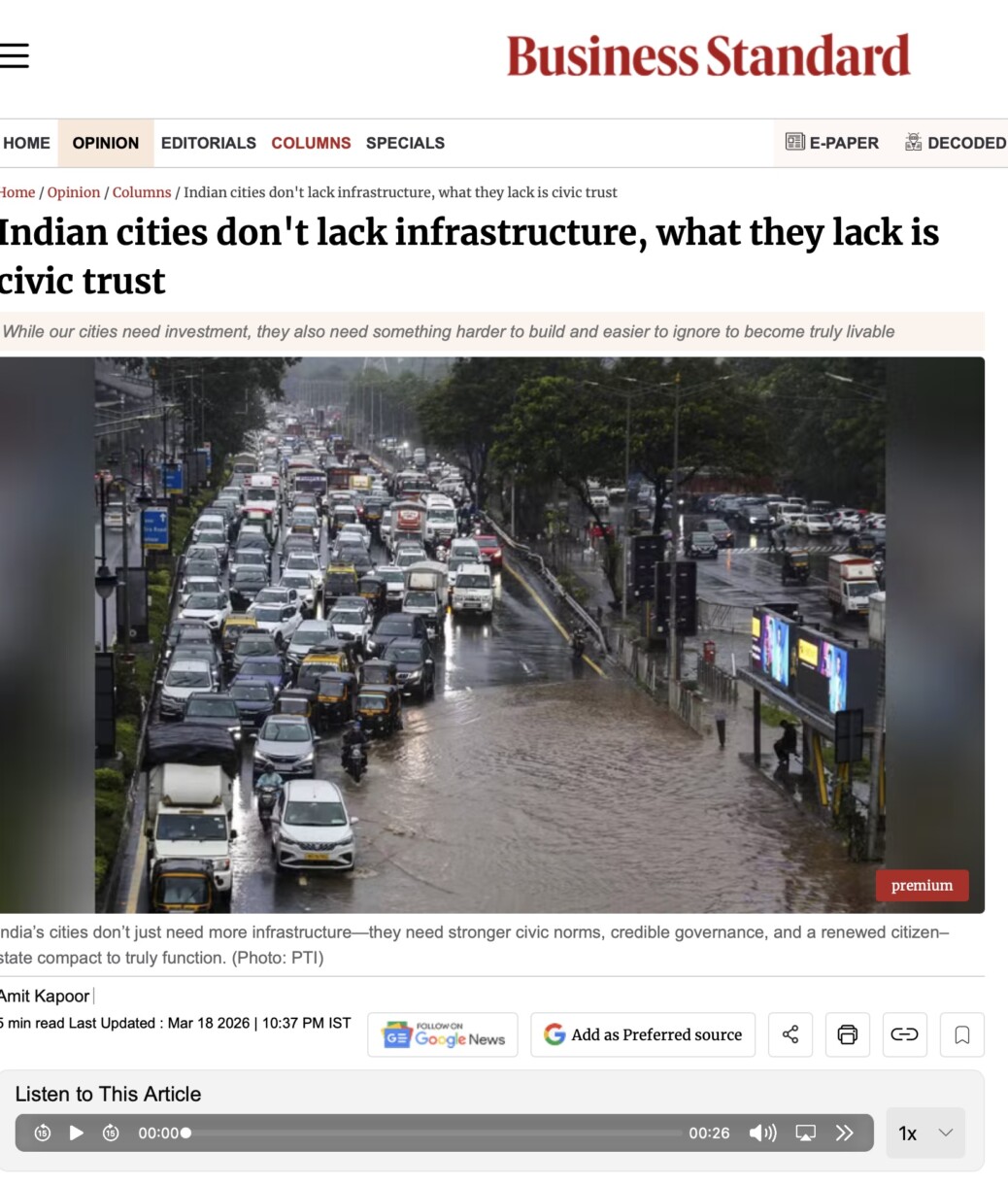
Indian cities are learning to do very modern things in very old ways. You can order groceries in ten minutes, pay a street vendor with UPI, track your bus on an app and work from a glass tower plugged into the global economy. Then the rain comes, a junction locks up, garbage spills onto the service lane, a footpath disappears into parked cars, and the city reverts to negotiation. That is the invisible fault line this years’ Economic Survey also identifies: a weak civic compact between citizens and the state that leaves Indian cities struggling to convert investment into order and growth into liveability.
This is a more interesting diagnosis than the usual perspective that Indian cities simply need more money, more roads or more flyovers. While they do need investment, they also need something harder to build and easier to ignore. Cities need a widely shared understanding that public rules are real, public space is shared, and compliance is not for the naïve.
What may appear abstract is in fact deeply practical, for it determines whether traffic signals coordinate movement or simply function as suggestions, whether housing plans guide urban growth or are gradually hollowed out by exceptions and encroachments, and whether waste segregation campaigns reshape everyday habits or remain confined to PowerPoint slides.
India’s cities are now too economically important for this to remain a side issue. Urban India already produces the bulk of national output and will absorb much of the country’s future demographic and economic change. The World Bank has estimated that by 2036, India’s towns and cities could account for around 70 per cent of GDP. The standard urban conversation in India still tends to be physical. Yet the harder truth is that cities are not merely engineering project but they are large systems of cooperation among strangers. Their success depends on whether millions of people believe rules will be applied predictably and whether the state itself behaves as though enforcement is routine rather than theatrical.
In India, urban systems falter less from a shortage of rules than from weak expectations that those rules will hold. Studies of urban governance show that compliance depends heavily on perceived legitimacy and credible enforcement, not simply regulation density. In many Indian cities the gap between rule and practice is visible in everyday coordination failures. Bengaluru commuters now lose roughly 168 hours a year to congestion, while average peak speeds fall below 14 km/h, illustrating how behavioural and institutional frictions compound infrastructure limits. Such patterns are well documented in urban economics: when enforcement appears uneven and procedures opaque, citizens rationally adapt. Signals become negotiable, regulations elastic, and informal workarounds gradually emerge as the practical operating system of the city.
India’s urban history helps explain why this equilibrium has proven stubborn. Colonial municipalities were designed more to administer than to empower. Post-independence urbanisation then expanded at a speed that governance systems never fully matched. Cities grew outward, institutions remained fragmented, and informal arrangements filled the gap between official rules and lived reality. Over time, the city became a place where legality and practicality diverged.
This is visible in everything from land markets to traffic. India does not merely have congestion. It has a culture of negotiated movement. It does not merely have unaffordable housing. It has a planning system whose formal rigidity often pushes people toward informal solutions. It does not merely have waste problems. It has an urban commons problem, where the public realm is everyone’s concern in theory and too often no one’s responsibility in practice.
Even so, the picture is not bleak, and it should not be narrated that way. Indian cities also contain evidence that civic norms can shift. Indore’s improvement in sanitation was not just a matter of trucks and bins. It involved sustained signalling that rules would be followed, monitored and socially reinforced. Digital tolling, GPS-tracked buses, online building approvals and direct benefit systems all show that Indian urban governance can reduce friction when it chooses process over discretion. The lesson is not that technology will save the city. Technology without trust often just digitises dysfunction. The real lesson is that norms change when institutions become more credible. People adapt quickly to systems that are clear, fair and reliably enforced.
This has major implications for urban policy. The next generation of reform cannot be confined to capital expenditure. It has to include boring but foundational tasks: clearer municipal accountability, fewer overlapping agencies, simpler rules, faster approvals, better local enforcement and more visible consequences for non-compliance. It also requires treating citizens as partners rather than as obstacles or passive recipients. Ward-level participation, resident monitoring, vendor integration, decentralised waste systems and neighbourhood stewardship are not sentimental add-ons. They are ways of rebuilding the civic bargain at a human scale.
The most relevant question for Indian urban policy now is not whether cities need more infrastructure. They do. The more important question is whether India can build cities where public systems are trusted enough, and public behaviour aligned enough, for infrastructure to work as intended. The invisible fault line is not a metaphor for urban chaos. It is a description of a deeper institutional fragility in cities that look increasingly modern from above but remain unstable in everyday use. India’s urban future will not be decided only by how much concrete it pours. It will be decided by whether it can make civic life less negotiable, public authority more credible, and shared spaces genuinely shared. Once that happens, Indian cities will not merely grow bigger, but they will start working better
The article was published with Business Standard on March 18, 2026.