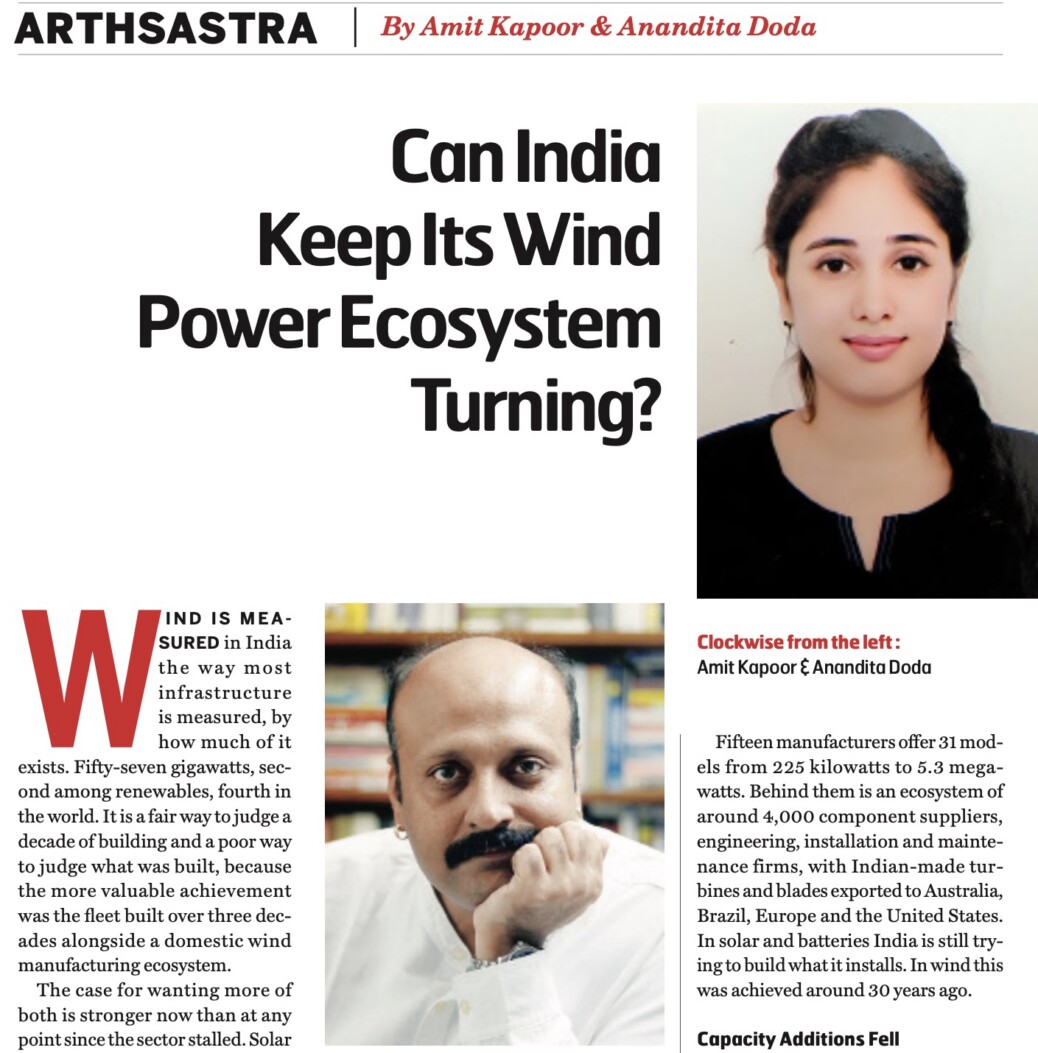
By Amit Kapoor and Anandita Doda
Wind is measured in India the way most infrastructure is measured, by how much of it exists. Fifty-seven gigawatts, second among renewables, fourth in the world. It is a fair way to judge a decade of building and a poor way to judge what was built, because the more valuable achievement was the fleet built over three decades alongside a domestic wind manufacturing ecosystem.
The case for wanting more of both is stronger now than at any point since the sector stalled. Solar has taken the daytime convincingly, but it stops at dusk. On 2023 data, outside solar hours thermal met around 80 per cent of Indian demand while wind met about six per cent. Wind blows hardest at night and through the monsoon, precisely when solar falls away. Had India reached its 60 GW target for 2022, wind could have covered as much as 14.5 per cent of non-solar demand instead of 6.3. The fourteenth National Electricity Plan now asks for 122 GW by 2032, requiring 22 per cent annual growth, and 21 states have written wind into their 2030 plans, several with almost no wind of their own.
What separates this ambition from India’s others is that the machinery can be built here, and largely it is. MNRE puts annual turbine manufacturing capacity at around 20 GW, with a further 15 GW of annual blade capacity. Domestic value addition is estimated at 70 to 80 per cent across blades, towers, gearboxes and other components, against domestic demand of seven to eight gigawatts. Fifteen manufacturers offer 31 models from 225 kilowatts to 5.3 megawatts. Behind them is an ecosystem of around 4,000 component suppliers, engineering, installation and maintenance firms, with Indian-made turbines and blades exported to Australia, Brazil, Europe and the United States. In solar and batteries India is still trying to build what it installs. In wind this was achieved around thirty years ago.
This is also what made the last decade so expensive. A factory sized for 20 GW and fed seven cannot hold its suppliers together indefinitely. Accelerated depreciation and the generation-based incentive were withdrawn in 2012 and restored in 2014, and the shift from feed-in tariffs to reverse auctions in 2017 took the ground out entirely. Annual additions fell from 5.5 GW in 2016-17 to under 1.8 GW the year after and lower again after that. Turbine makers ran at a fraction of capacity while the smaller firms around them pivoted into other work, which is not a loss that reverses when orders return. Generation reached about 106.7 billion units in 2025-26 against 83 billion in each of the two preceding years, and 6.1 GW went up. The recovery is real, and it is the sector’s second, and the supply chain is pricing in a third collapse it has no reason to rule out.
The trouble with a localisation figure is that it counts value, not difficulty. India makes seventy to eighty per cent of a turbine by value and still imports the components that decide what it costs. Special bearings, gearboxes, yaw systems and controllers are still imported, and China supplies roughly half of India’s hub castings and ninety per cent of its gearbox castings. An Indian turbine costs thirty to sixty per cent more than a Chinese one, much of it traceable to those inputs. Approved List of Models and Manufacturers (ALMM) is pushing hub and nacelle assembly onshore and reaching towards blades, towers and gearboxes, which is the right instinct and, in the near term, another squeeze, because supply chains localise no faster than they can be financed.
All of which is why the industry’s most important unbuilt component is not a factory alone but a system for taking machines apart.
A turbine runs twenty to twenty-five years, and India’s earliest are past that. The National Institute of Wind Energy puts repowering potential at roughly 25.4 GW among turbines below 2 MW, though that is a capacity class rather than an age cohort, and the genuinely elderly fleet is nearer 1.6 GW. Around 85 to 90 per cent of a turbine by mass is steel, iron, copper, concrete and mechanical equipment that existing recycling channels handle, and the gearboxes, generators and tower sections in that fraction are precisely what India imports.
The blades do not resolve themselves. They bond glass or carbon fibre in thermosetting resin, creating the durability that carries them through two decades of loading but makes them impossible to pull apart afterwards. India generated 9,883 tonnes of blade waste in 2024-25, a trivial figure that will not stay trivial. Cement kilns can take shredded composite as fuel and mineral feed under rules India already has. However, nobody collects a blade, moves it, or shreds it first.
India has watched this once already. Nearly 54 GW of solar was standing by March 2022, and modules entered the E-Waste Rules only that November. Wind has no end-of-life framework at all, and the 2016 and 2023 repowering policies have barely been implemented, held up by ownership fragmented across thousands of small buyers who acquired turbines as tax instruments in the accelerated depreciation years. That fragmentation is itself the case for placing the obligation on manufacturers, who are the only party left to hold to anything. Pair the repowering incentive, which cuts payback from thirteen years to three or four, with recovery obligations and material disclosure requirements as the ALMM is expanded. The government of India has recognised that repowering old sites is not merely a waste management exercise but one of the quickest ways to add productive wind capacity.
India rarely gets to own a clean energy supply chain outright and that is why owning the wind ecosystem is a remarkable opportunity. The question now isn’t how quickly the turbines go up, but whether a country that learned to build them intends to learn to take them back.
(Amit Kapoor is Chair and Anandita Doda is Researcher at Institute for Competitiveness.)
The article was published with Business World on August 13, 2026.