By Amit Kapoor
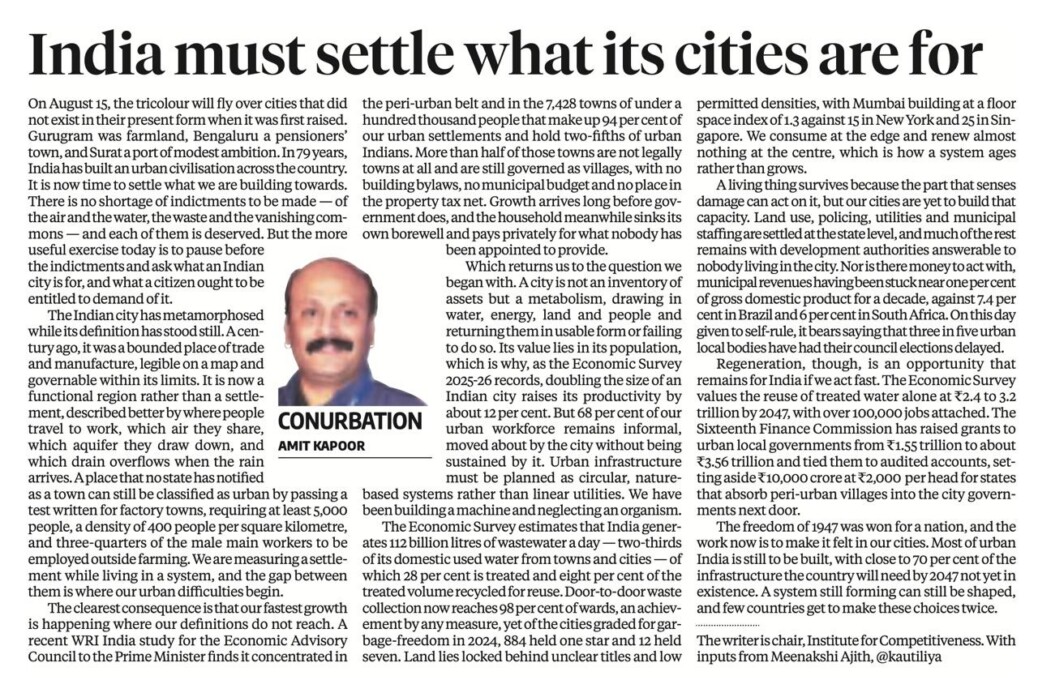
Today the tricolour flies over cities that did not exist in their present form when it was first raised. Gurugram was farmland, Bengaluru a pensioners’ town and Surat was a port of modest ambition. In seventy-nine years, India has built an urban civilisation across the country. It is now time to settle what we are building towards. There is no shortage of indictments to be made, of the air and the water, the waste and the vanishing commons, and each of them is deserved. But the more useful exercise today is to pause before the indictments and ask what an Indian city is for, and what a citizen ought to be entitled to demand of it.
The Indian city has metamorphosed while its definition has stood still. A century ago, it was a bounded place of trade and manufacture, legible on a map and governable within its limits. It is now a functional region rather than a settlement, described better by where people travel to work, which air they share, which aquifer they draw down, and which drain overflows when the rain arrives. Yet a place that no state has notified as a town still becomes urban only by passing a test written for factory towns, requiring five thousand people, four hundred of them to the square kilometre, and three-quarters of the male main workers employed outside farming. We are measuring a settlement while living in a system, and the gap between them is where our urban difficulties begin.
The clearest consequence is that our fastest growth is happening where our definitions do not reach. A recent WRI India study for the Prime Minister’s Economic Advisory Council finds it concentrated in the peri-urban belt and in the 7,428 towns of under a hundred thousand people that make up ninety-four per cent of our urban settlements and hold two-fifths of urban Indians. More than half of those towns are not legally towns at all and are still governed as villages, with no building bylaws, no municipal budget and no place in the property tax net. Growth arrives long before government does, and the household meanwhile sinks its own borewell and pays privately for what nobody has been appointed to provide.
Which returns us to the question we began with. A city is not an inventory of assets but a metabolism, drawing in water, energy, land and people and returning them in usable form or failing to do so. Its density is circulation, which is why, as the Economic Survey2025-26 records, doubling the size of an Indian city raises its productivity by about 12%. But circulation is not nourishment, and 68% of our urban workforce remains informal, moved about by the city without being sustained by it. Urban infrastructure must be planned as circular, nature-based systems rather than linear utilities. We have been building a machine and neglecting an organism.
The Economic Survey estimates that India generates 112 billion litres of wastewater a day, two-thirds of it domestic used water from towns and cities, of which 28 per cent is treated and eight per cent of the treated volume recycled for reuse. Door-to-door waste collection now reaches 98 per cent of wards, an achievement by any measure, yet of the cities graded for garbage-freedom in 2024, 884 held one star and twelve held seven. Land lies locked behind unclear titles and low permitted densities with Mumbai building at a floor space index of 1.3 against fifteen in New York and twenty-five in Singapore. We consume at the edge and renew almost nothing at the centre, which is how a system ages rather than grows.
A living thing survives because the part that senses damage can act on it, but our cities are yet to build that capacity. Land use, policing, utilities and municipal staffing are settled at the state level, and much of the rest with development authorities answerable to nobody living in the city. Nor is there money to act with, municipal revenues having been stuck near one per cent of GDP for a decade against 7.4 per cent in Brazil and six in South Africa, and urban infrastructure drawing twenty-six dollars a person a year. On this day given to self-rule, it bears saying that three in five urban local bodies have had their council elections delayed.
Regeneration, though, is an opportunity that remains for India if we act fast. The Economic Survey values the reuse of treated water alone at 2.4 to 3.2 lakh crore rupees by 2047, with over a lakh of jobs attached. The Sixteenth Finance Commission has raised grants to urban local governments from 1.55 to about 3.56 lakh crore rupees and tied them to audited accounts, setting aside 10,000 crore at 2,000 rupees a head for states that absorb peri-urban villages into the city governments next door, which regenerates the governing tissue rather than the concrete.
The freedom of 1947 was won for a nation, and the work now is to make it felt on our cities. Most of urban India is still to be built, with close to seventy per cent of the infrastructure the country will need by 2047 not yet in existence. A system still forming can still be shaped, and few countries get to make these choices twice. The Indian flag will be hoisted this morning over the fastest-growing cities on earth, and there is no reason it should not one day rise over the best-governed ones.
(Amit Kapoor is chair, Institute for Competitiveness. With inputs from Meenakshi Ajith. X: @kautiliya)
The article was published with Business Standard on August 13, 2026.