By Amit Kapoor and Kartik
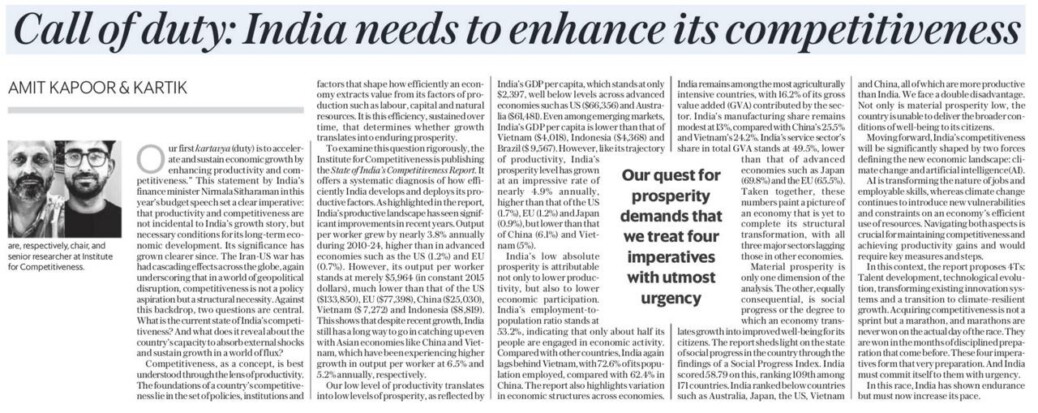
“Our first Kartavya is to accelerate and sustain economic growth by enhancing productivity and competitiveness”: these opening remarks from India’s Finance Minister in the 2026 Union Budget speech set a clear imperative: that productivity and competitiveness are not incidental to India’s growth story, but necessary conditions for its long-term economic development. The significance of this framing has only grown since. The Iran-US War has sent cascading effects through the global order, once again underscoring that in a world of persistent geopolitical disruption, competitiveness is not a policy aspiration but a structural necessity. Against this backdrop, two questions become central: What is the current state of India’s competitiveness? And what does it reveal about the country’s capacity to absorb external shocks and sustain growth in a reordering world?
Competitiveness, as a concept, is best understood through the lens of productivity. The foundations of a country’s competitiveness lie in the set of policies, institutions, and factors that shape how efficiently an economy extracts value from its factors of production such as labour, capital, and natural resources. It is this efficiency, sustained over time, that determines whether growth translates into durable prosperity.
To examine this question rigorously, the Institute for Competitiveness recently published the State of India’s Competitiveness Report. The report offers a systematic diagnosis of how efficiently India develops and deploys its productive factors. It builds on the Competitiveness Roadmap for India@100, released by IFC under the auspices of the EAC-PM in 2022, while going significantly further situating India’s competitiveness within the current global landscape and benchmarking it against a carefully selected group of advanced and emerging economies.
As highlighted in the report, India’s productive landscape has seen significant improvements in recent years. India’s Output per worker grew by 3.76% annually during 2010-24, higher than in advanced economies such as the United States (1.18%) and the EU (0.65%). However, its output per worker stands at merely $5,964 (constant 2015 $), much lower than that of the US ($133,850), the EU ($ 77,398) and even against its South Asian counterparts, i.e. China ($ 25,030), Vietnam ($ 7,272) and Indonesia ($ 8,819). This shows that despite recent growth, India still has a way to go compared with both advanced economies and its peers like China and Vietnam, which have been experiencing higher growth in output per worker at 6.52% and 5.22% annually, respectively.
The low level productivity further translates into lower levels of prosperity in the economy as reflected by the GDP per capita of the country standing at only $ 2,397, well below the levels across advanced economies such as USA ($66,356) and Australia ($ 61,481), Even against its peers, India’s GDP per capita levels are lower than the levels in Vietnam ($ 4,018), Indonesia ($4,368) and Brazil ($ 9,567). However, like the trajectory of productivity, India’s prosperity levels have grown at an impressive rate of 4.85% annually, higher than that of the US (1.68%), EU (1.24%) and Japan (0.86%), but lower than that of China (6.05%) and Vietnam (5.01%).
The low prosperity levels are attributed not only to lower productivity but also to lower economic participation. India’s employment-to-population ratio, a key metric of economic participation, stands at 53.23%, indicating that only about 50% of the population is engaged in economic activity. Compared with other countries, India again lags behind Vietnam, with 72.63% of its population employed, compared with 62.4% in China. The report also highlights variation in economic structures across economies. Among its peers, India remains the most agriculturally intensive country, with 16.19% of its GVA being contributed by the sector. India’s manufacturing share remains modest at 13.02%, compared with China’s 25.5% and Vietnam’s 24.18%. India’s service sector’s share in total GVA stands at 49.51%, lower than that of advanced economies such as Japan (69.77%) and the EU (65.5%). Taken together, these numbers paint a picture of an economy that is yet to complete its structural transformation, with a high share of low-productive agriculture, not a fully grown manufacturing sector and a service sector, which is dominant but has not reached the scales and characteristics of other advanced economies.
Material prosperity is only one dimension of productive capacity. The other, equally consequential, is social progress or the degree to which an economy translates growth into improved well-being for its citizens. The report sheds light on the state of social progress in the country through the findings of the Social Progress Index. India scored 58.79 on the Social Progress Index, ranking 109th among 171 countries. India ranked below countries such as Australia, Japan, the US, Vietnam & China, countries highly productive as compared to India, indicating a compounding disadvantage where not only is the material prosperity restrained, but simultaneously the country is unable to deliver the broader conditions of well-being to its citizens.
Moving forward, India’s competitiveness will be significantly shaped by two forces defining the new economic landscape: climate change and Artificial Intelligence. AI is continuously transforming the nature of jobs and employability skills, whereas climate change continues to introduce new vulnerabilities and constraints on an economy’s efficient use of resources. Navigating both aspects is crucial for maintaining competitiveness and achieving productivity gains in the current landscape and would require key measures and steps. In this context, the report proposes 4Ts, i.e., Talent development, Technological evolution, Transforming existing innovation systems, and Transition to climate-resilient growth. Building competitiveness is not a sprint but a marathon, and marathons are never won on race day. They are won in the months of disciplined preparation that come before. These four imperatives form that very preparation, and India must commit to them with urgency, for in this race, the India has the endurance, but must now find the pace.
(Amit Kapoor is chair & Kartik, Senior Researcher at Institute for Competitiveness. X: @kautiliya).
The article was published with Mint on May 10, 2026.