Barely a month after announcing a farm loan waiver of more than ₹36,500 crore, the Maharashtra government has approved another major relief measure by waiving nearly ₹48,000 crore in pending electricity dues for farmers. Undoubtedly, such interventions by state governments can provide much needed financial relief and reflect the government’s commitment to addressing agrarian distress. Such relief measures have become a recurring feature across the state governments’ agricultural policy, which is not fiscally sustainable in the long run. This raises a more fundamental question: can government expenditure on agriculture be restructured so that it builds durable farm incomes, rather than periodically compensating when incomes falter?
For decades, public investment has transformed Indian agriculture. The Green Revolution of the late 1960s was driven by HYV seeds, Minimum support prices, procurement, subsidised electricity, fertilisers and irrigation, which enabled this remarkable transition. But Indian agriculture has entered a new phase now as sustaining food security requires an agricultural system that also delivers stable farmer incomes, uses natural resources efficiently and remains resilient to a changing climate.
This shift requires rethinking not how much governments spend on agriculture, but where those resources are directed. Punjab and Haryana illustrate why. Together, they form the backbone of India’s paddy procurement system and receive extensive public support. Yet the economics reveal an important imbalance.
A recently published report by the Institute for Competitiveness (IFC) titled “A Pathway to Doubling Farmers’ Income: Reducing Reliance on Paddy Production and Incentivising Millet Production in Indian Agriculture”, finds that the public expenditure on paddy cultivation is nearly three times the gross profits earned by farmers on every hectare of the crop sown. While in Punjab, the public expenditure amounts to around ₹1.55 lakh per hectare, the gross profit earned by paddy farmers amounts to ₹53,479 per hectare. Meanwhile, in Haryana, the public expenditure amounts to around ₹83,836 per hectare, whereas the farmers earn a gross profit of approximately ₹30,048 per hectare only. These figures do not suggest that public spending is excessive. Rather, they suggest an opportunity to ask whether a part of this expenditure can be deployed in ways that generate higher and more resilient farm incomes. The debate surrounding crop diversification offers an answer.
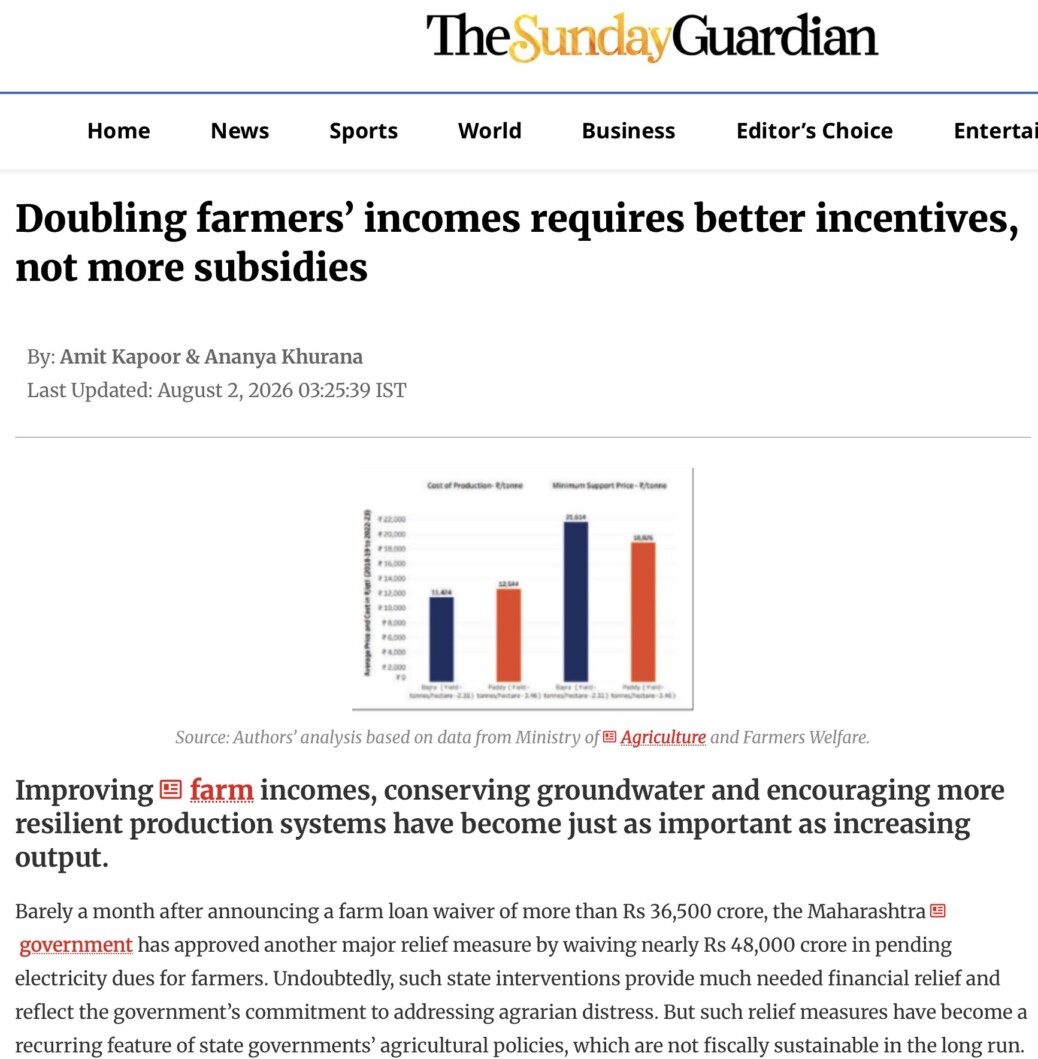
For years, governments have encouraged farmers to shift from excessive production of water-intensive paddy towards more environmentally sustainable crops such as millets. The case appears convincing as millets require considerably less water, fewer chemical inputs and are better equipped to withstand increasingly frequent climate shocks, including El Nino episodes. During 2023–24, bajra commanded a minimum support price that was more than ₹10,000 per tonne higher than paddy and cost less than half as much to cultivate, particularly in Haryana. Even then, farmers vehemently continued to grow paddy.

Figure 1: Source: Author’s analysis based on data from Ministry of Agriculture and Farmers Welfare
While bajra offers an advantage in support prices and production costs, paddy performs better on two factors that ultimately determine income. It produces higher yields of 3.56 tonnes per hectare compared with 2.31 tonnes for bajra, and it benefits from assured procurement. Moreover, between 2018–19 and 2022–23, the Food Corporation of India procured nearly six million tonnes of paddy annually in Haryana, whereas procurement of bajra accounted for barely 0.002% of that volume.
The income difference follows naturally. Paddy generates around ₹30,000 per hectare in net returns in Haryana, compared with ₹28,164 for bajra. In Punjab, the difference is starker as paddy generates nearly ₹48,500 per hectare which is almost seven times the returns from bajra. Farmers are therefore responding rationally to the incentives embedded in the system. Their cropping decisions are guided not by support prices or costs alone, but by the income they can realistically expect to earn.
This distinction has important implications for policy. Farmers assess prices, yields, cultivation costs and market assurance together because each contributes to expected income. Improving only one of these variables rarely changes cropping behaviour for the long-term. This same logic should also guide how public spending is allocated to shape farmers’ cropping choices.
India’s agricultural support architecture was designed when increasing food production was the overriding national priority. Today, nearly six decades later, Indian agriculture has different objectives to meet. Improving farm incomes, conserving groundwater and encouraging more resilient production systems have become just as important as increasing output. Public expenditure must therefore evolve from supporting production alone to creating incentives that respond to the economic and environmental challenges faced by the present-day agricultural landscape.
One way to achieve this is by redesigning farmer incentives rather than expanding public spending. The IFC report finds that the current diversification incentive of around ₹17,500 per hectare in Punjab and Haryana is far too small to persuade farmers to move away from paddy because it falls well below the income they forgo by doing so. Instead, it recommends an income-neutral cash incentives of about ₹53,480 per hectare, ensuring that farmers are no worse off financially if they diversify. Financed through a partial repurposing of existing paddy subsidies and complemented by investments in soil restoration, stronger millet value chains and assured procurement, such incentives would substantially reduce the economic risks of diversification. Simulation estimates suggest that, alongside higher MSPs for millets, this approach could significantly increase farmers’ incomes. An added advantage is that repurposing existing subsidies in this manner could generate an estimated ₹6.36 lakh crore in fiscal savings over the next decade, creating gains not only for farmers and the environment but also for the public exchequer.
The debate on agricultural support therefore needs to evolve, just as India’s agriculture priorities have evolved. India’s agricultural transformation succeeded because policy focused persistently on increasing food production. The next one must focus just as intentionally on creating greater prosperity for farmers. As doubling farmers’ incomes will depend not simply on larger budgets, but on better aligned incentives that ensure every rupee of public spending contributes to a stronger, more resilient and more sustainable farm incomes.
(Amit Kapoor is chair & Ananya Khurana, Senior Researcher at the Institute for Competitiveness. X: @kautiliya).
The article was published with The Sunday Guardian on August 2, 2026.