By Amit Kapoor and inputs from Nandini Vats
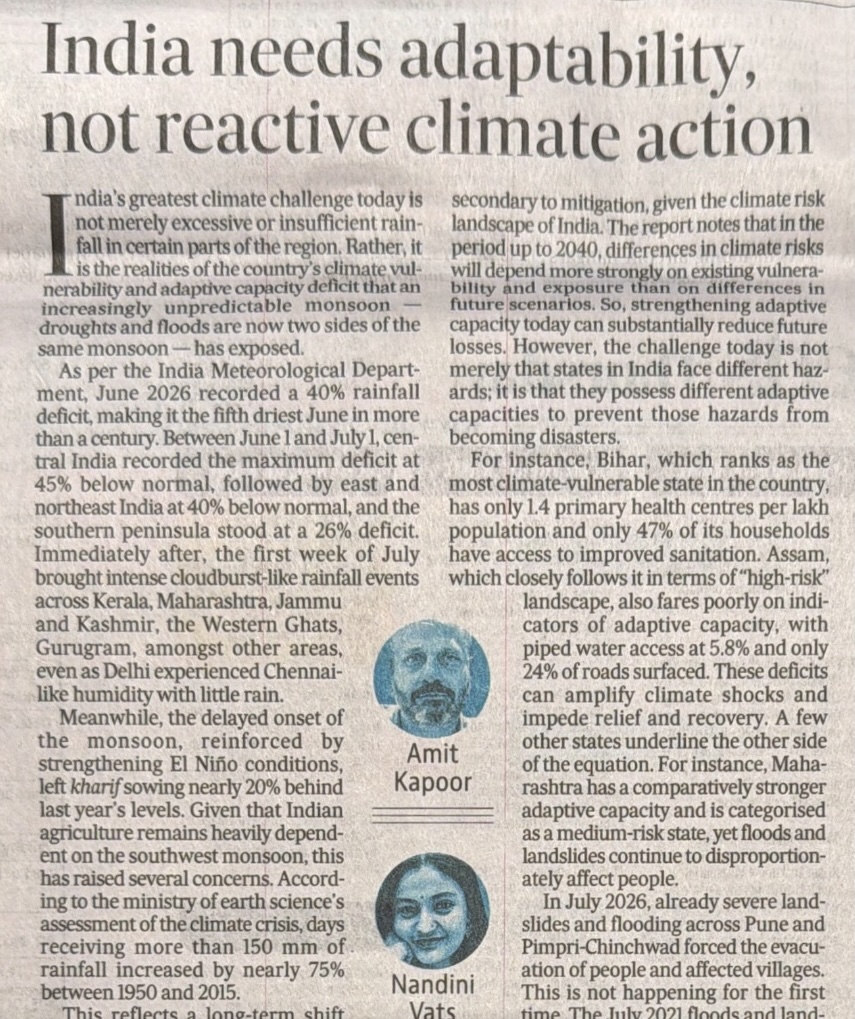
India’s greatest climate challenge today is not merely excessive or insufficient rainfall in certain parts of the region. Rather, it is the realities of the country’s climate vulnerability and adaptive capacity deficit that an increasingly unpredictable monsoon — droughts and floods are now two sides of the same monsoon — has exposed.
As per the India Meteorological Department, June 2026 recorded a 40% rainfall deficit, making it the fifth driest June in more than a century. Between June 1 and July 1, central India recorded the maximum deficit at 45% below normal, followed by east and northeast India at 40% below normal, and the southern peninsula stood at a 26% deficit. Immediately after, the first week of July brought intense cloudburst-like rainfall events across Kerala, Maharashtra, Jammu and Kashmir, the Western Ghats, Gurugram, amongst other areas, even as Delhi experienced Chennai-like humidity with little rain.
Meanwhile, the delayed onset of the monsoon, reinforced by strengthening El Niño conditions, left kharif sowing nearly 20% behind last year’s levels. Given that Indian agriculture remains heavily dependent on the southwest monsoon, this has raised several concerns. According to the ministry of earth science’s assessment of the climate crisis, days receiving more than 150 mm of rainfall increased by nearly 75% between 1950 and 2015. This reflects a long-term shift rather than a recent anomaly with widespread extreme rainfall events across central India having tripled over the same period even as average monsoon rainfall declined. The evidence is clear: El Niño may influence when the monsoon arrives, but it can’t alone explain the increasingly erratic and destructive rainfall pattern now unfolding across India.
This pattern is exposing a deeper structural challenge: India’s climate response is reactive and uneven. In many states, adaptive capacity to prepare for and respond to climate variability, and strengthen institutions and planning systems, remains constrained. The scale of the deficit in adaptive capacity is evident in The Climate Risk and Vulnerability Assessment 2025 report by the Institute for Competitiveness, which presents a detailed picture of climate risk vulnerabilities across India’s 28 states. The report notes that more than half of Indian states face above-average climate vulnerability, while most states share similar risk profiles. Regarding adaptive capacity, 16 out of 28 states score above the national average, indicating that the same rainfall can produce vastly different outcomes depending on the quality of governance, infrastructure, healthcare, and early warning systems.
The report also discusses the 2015-16 El Niño episode, which intensified drought conditions across several regions globally, as an example of how climatic variability can turn existing stress into wider systemic disruption. In India, in states with weaker water systems, climate-dependent livelihoods, and limited disaster response infrastructure, the same climatic anomaly is likely to produce deeper and longer-lasting consequences.
This is also why adaptation cannot remain secondary to mitigation, given the climate risk landscape of India. The report notes that in the period up to 2040, differences in climate risks will depend more strongly on existing vulnerability and exposure than on differences in future scenarios. So, strengthening adaptive capacity today can substantially reduce future losses. However, the challenge today is not merely that states in India face different hazards; it is that they possess different adaptive capacities to prevent those hazards from becoming disasters.
For instance, Bihar, which ranks as the most climate-vulnerable state in the country, has only 1.4 primary health centres per lakh population and only 47% of its households have access to improved sanitation. Assam, which closely follows it in terms of “high-risk” landscape, also fares poorly on indicators of adaptive capacity, with piped water access at 5.8% and only 24% of roads surfaced. These deficits can amplify climate shocks and impede relief and recovery. A few other states underline the other side of the equation. For instance, Maharashtra has a comparatively stronger adaptive capacity and is categorised as a medium-risk state, yet floods and landslides continue to disproportionately affect people. In July 2026, already severe landslides and flooding across Pune and Pimpri-Chinchwad forced the evacuation of people and affected villages. This is not happening for the first time. The July 2021 floods and landslides affected over 1,000 villages and displaced more than 375,000 people. Together, these examples show that vulnerability is not uniform across states; it is shaped by varying combinations of weak services, infrastructure gaps, local preparedness, and the scale of exposure. Even stronger adaptive capacity can reduce vulnerability, but cannot eliminate it.
Building a climate-resilience strategy is imperative for all states. This requires a shift from reactive, short-term disaster response to long-term, proactive adaptation through better climate risk mapping, climate-resilient infrastructure, strong early warning systems. El Niño is only half the story; the other half is institutionalised preparedness and governance. The real challenge is the uneven capacity of states to anticipate, prepare for, and adapt to increasingly climate-risk-laden landscapes. Aggregated state-level numbers may conceal substantial vulnerabilities, even though the variability of hazards and exposure is heterogeneous across districts and communities at the forefront of these impacts.
Strengthening adaptive capacity by building climate-resilient infrastructure, early warning systems, and local institutions’ capabilities, and by implementing anticipatory planning — all these “solutions” can prevent climate hazards from turning into prolonged public health, livelihood, and economic crises. At this point, what is required is anticipatory, inclusive adaptive capacity-building by state governments, not just stronger disaster response.
Amit Kapoor is chair, and Nandini Vats is researcher, Institute for Competitiveness.The views expressed are personal
The article was published with Hindustan Times on July 23, 2026.