By Amit Kapoor and Meenakshi Ajit
Growth, people and climate are one freedom
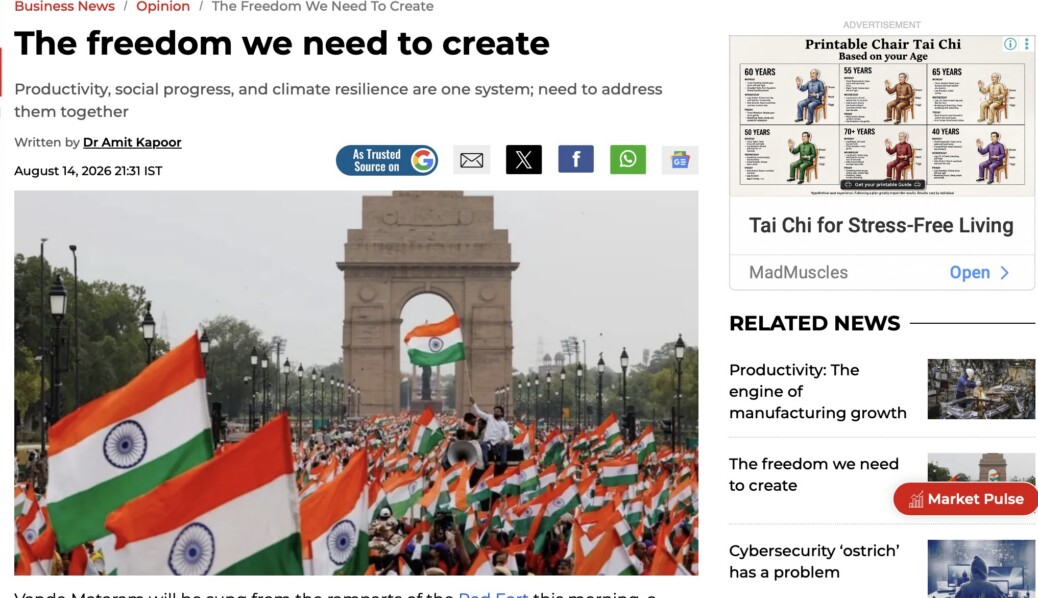
Vande Mataram will be sung from the ramparts of the Red Fort this morning, a hundred and fifty years after it was written. It was once sung by a generation that could not vote and could not sing these words in public and yet found in a few lines the conviction that the country was theirs to imagine. Seventy-nine years after they succeeded, the Republic they left behind remains the most audacious political wager of the last century, and it has not lost. Among the five thousand guests seated at the Red Fort today are street vendors, sanitation workers, metro staff and hospital orderlies, in enclosures named after India’s great lakes rather than after rank. It is a small gesture, and among the truest the Republic will make today.
Yet the country extending that welcome does so into a world its founders would not recognise, and which even those of us who came of age after 1991 are only beginning to make sense of. The open trading order that carried India’s rise has given way to managed interdependence, in which states and firms still depend on cross-border flows of technology, energy, capital and food while increasingly treating those flows as instruments of leverage. Tariffs have returned as a first-order instrument of statecraft, average American duties having climbed to levels last seen around 1910, and the world now finds itself amid a technology boom accompanied by a governance recession, rich in capital and capability yet unable to coordinate a response to any risk it holds in common.
This generation is being asked to fight for a freedom of a different kind, not from external rule, but from the constraints we have built or tolerated ourselves. It is a freedom that will be declared by nobody and can only be constructed, and it stands on three foundations, the growth that pays for everything, the human development that gives growth its purpose, and the environment that sets the terms on which both are possible. On the first, the measure that matters is not the size of the economy, but what each worker produces, and at 5,964 dollars of output per worker against 25,030 in China, India’s future will be shaped less by how fast it grows than by how productively it learns to grow.
Nothing reflected the significance of that more plainly this year than the free fall of the rupee. A currency that touched an all-time low near 97 to the dollar in May ought to have been a gift to exporters, and yet merchandise exports grew by 0.08 per cent, because a depreciation cannot conjure an industrial base where manufacturing contributes only 13 per cent of value added. The rest of the foundation also needs strengthening, with credit to the private sector at around 50 per cent of GDP, research and development at 0.65 per cent of national income, vocational training reaching 2.4 per cent of our fifteen- to twenty-four-year-olds, and barely half our working-age population in work at all. These are not separate failures but a single interlocking one, since a weakness in any of them limits what strength in the rest can deliver.
Nineteen Olympiad medallists will sit on the ramparts this morning. They are at the summit of a system that loses a great many of its climbers well before the top. It is therefore imperative to reflect today on India’s human capital continuum or the long passage that runs from early childhood learning through schooling and skilling into work. Our difficulty is not an absence of progress along it but the uneven transmission of progress from one stage to the next, with learning thinning as children rise through the grades and only 8.25 per cent of graduates holding roles that match their qualification. Our coveted demographic dividend is not paid out on population size but it needs to be earned through capability and absorption.
Our wider measures tell the same story. India’s Social Progress Index score of 58.79 this year places it 109th among 171 countries, and the trajectory matters more than the rank, since the score rose by 8.49 points between 2011 and 2021 and by barely 1.5 points in the four years since. Access has widened while outcomes have slowed, women remain outside the workforce in numbers no growing economy can afford, and the air and water of our cities quietly reduce how much work a person is able to do. Social progress is not the reward that arrives after growth but the mechanism by which growth becomes a life.
All of this now rests on a country whose weather has stopped behaving. Assam is under water as the flag goes up this morning, with about a hundred dead, many in relief camps and over 400 villages submerged. Other states in the country pass between drought and deluge within a single season. Heat alone is expected to take more than five per cent of South Asia’s working hours by 2030, most of them Indian and most of them belonging to the workers our industrial ambitions depend upon. We withdraw two-thirds of our renewable freshwater each year and consume 1.11 global hectares a person against a biocapacity of 0.33. These are not merely technical climate terms but lived realities which affect our fundamental existence and could lead to the next mass extinction of humanity.
So, the freedom to be built this Independence Day is of a different kind. It requires four transformations, from demographic scale to productive human capability, from digital reach to digital productivity, from pockets of innovation to an industrial ecosystem that can scale, and from linear growth to a circular and climate-consistent economy. None of these can be won on its own, because productivity, social progress and climate resilience are one system with each one having both negative and positive spillovers to the other. A country that treats them separately will keep solving one at the expense of another. That is the inward turn this year asks for, less a matter of new schemes than of resilience, of institutions that hold when the weather and the world turn at once.
The article was published with Financial Express on August 14, 2026.