By Amit Kapoor and Sheen Zutshi
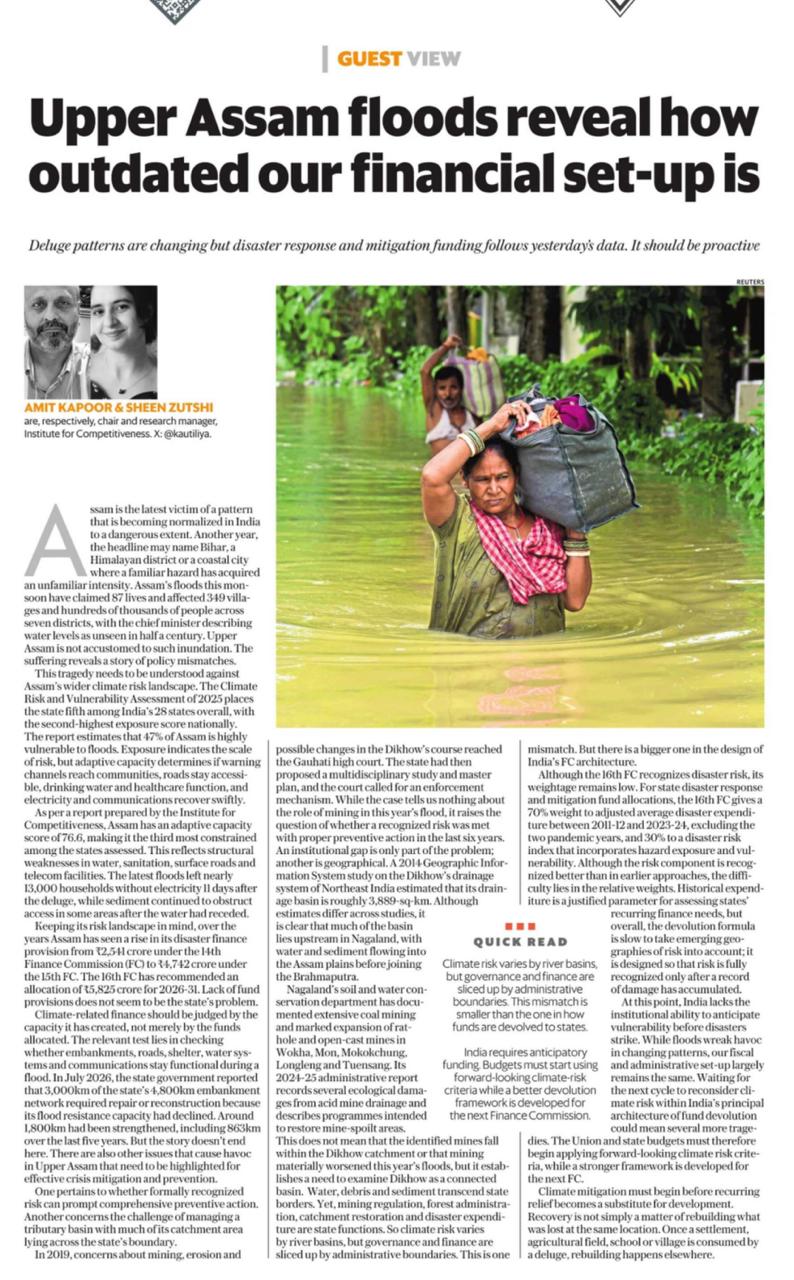
Assam is the latest victim of a pattern that is becoming normalized in India to a dangerous extent. Another year, the headline may name Bihar, a Himalayan district or a coastal city where a familiar hazard has acquired an unfamiliar intensity. Assam’s floods this monsoon have claimed 87 lives and affected 349 villages and hundreds of thousands of people across seven districts, with the chief minister describing water levels as unseen in half a century. Upper Assam is not accustomed to such inundation. The suffering reveals a story of policy mismatches.
This tragedy needs to be understood against Assam’s wider climate risk landscape. The Climate Risk and Vulnerability Assessment of 2025 places the state fifth among India’s 28 states overall, with the second-highest exposure score nationally. The report estimates that 47% of Assam is highly vulnerable to floods. Exposure indicates the scale of risk, but adaptive capacity determines if warning channels reach communities, roads stay accessible, drinking water and healthcare function, and electricity and communications recover swiftly.
As per a report prepared by the Institute for Competitiveness, Assam has an adaptive capacity score of 76.6, making it the third most constrained among the states assessed. This reflects structural weaknesses in water, sanitation, surface roads and telecom facilities. The latest floods left nearly 13,000 households without electricity 11 days after the deluge, while sediment continued to obstruct access in some areas after the water had receded.
Keeping its risk landscape in mind, over the years Assam has seen a rise in its disaster finance provision from ₹2,541 crore under the 14th Finance Commission (FC) to ₹4,742 crore under the 15th FC. The 16th FC has recommended an allocation of ₹5,825 crore for 2026-31. Lack of fund provisions does not seem to be the state’s problem.
Climate-related finance should be judged by the capacity it has created, not merely by the funds allocated. The relevant test lies in checking whether embankments, roads, shelter, water systems and communications stay functional during a flood. In July 2026, the state government reported that 3,000km of the state’s 4,800km embankment network required repair or reconstruction because its flood resistance capacity had declined. Around 1,800km had been strengthened, including 863km over the last five years. But the story doesn’t end here. There are also other issues that cause havoc in Upper Assam that need to be highlighted for effective crisis mitigation and prevention.
One pertains to whether formally recognized risk can prompt comprehensive preventive action. Another concerns the challenge of managing a tributary basin with much of its catchment area lying across the state’s boundary.
In 2019, concerns about mining, erosion and possible changes in the Dikhow’s course reached the Gauhati high court. The state had then proposed a multidisciplinary study and master plan, and the court called for an enforcement mechanism. While the case tells us nothing about the role of mining in this year’s flood, it raises the question of whether a recognized risk was met with proper preventive action in the last six years. An institutional gap is only part of the problem; another is geographical. A 2014 Geographic Information System study on the Dikhow’s drainage system of Northeast India estimated that its drainage basin is roughly 3,889-sq-km. Although estimates differ across studies, it is clear that much of the basin lies upstream in Nagaland, with water and sediment flowing into the Assam plains before joining the Brahmaputra.
Nagaland’s soil and water conservation department has documented extensive coal mining and marked expansion of rat-hole and open-cast mines in Wokha, Mon, Mokokchung, Longleng and Tuensang. Its 2024-25 administrative report records several ecological damages from acid mine drainage and describes programmes intended to restore mine-spoilt areas. This does not mean that the identified mines fall within the Dikhow catchment or that mining materially worsened this year’s floods, but it establishes a need to examine Dikhow as a connected basin. Water, debris and sediment transcend state borders. Yet, mining regulation, forest administration, catchment restoration and disaster expenditure are state functions. So climate risk varies by river basins, but governance and finance are sliced up by administrative boundaries. This is one mismatch. But there is a bigger one in the design of India’s FC architecture.
Although the 16th FC recognizes disaster risk, its weightage remains low. For state disaster response and mitigation fund allocations, the 16th FC gives a 70% weight to adjusted average disaster expenditure between 2011-12 and 2023-24, excluding the two pandemic years, and 30% to a disaster risk index that incorporates hazard exposure and vulnerability. Although the risk component is recognized better than in earlier approaches, the difficulty lies in the relative weights. Historical expenditure is a justified parameter for assessing states’ recurring finance needs, but overall, the devolution formula is slow to take emerging geographies of risk into account; it is designed so that risk is fully recognized only after a record of damage has accumulated.
At this point, India lacks the institutional ability to anticipate vulnerability before disasters strike. While floods wreak havoc in changing patterns, our fiscal and administrative set-up largely remains the same. Waiting for the next cycle to reconsider climate risk within India’s principal architecture of fund devolution could mean several more tragedies. The Union and state budgets must therefore begin applying forward-looking climate risk criteria, while a stronger framework is developed for the next FC.
Climate mitigation must begin before recurring relief becomes a substitute for development. Recovery is not simply a matter of rebuilding what was lost at the same location. Once a settlement, agricultural field, school or village is consumed by a deluge, rebuilding happens elsewhere.
Amit Kapoor & Sheen Zutshi are, respectively, chair and research manager, Institute for Competitiveness. X: @kautiliya.
The article was published in Mint on August 6, 2026.