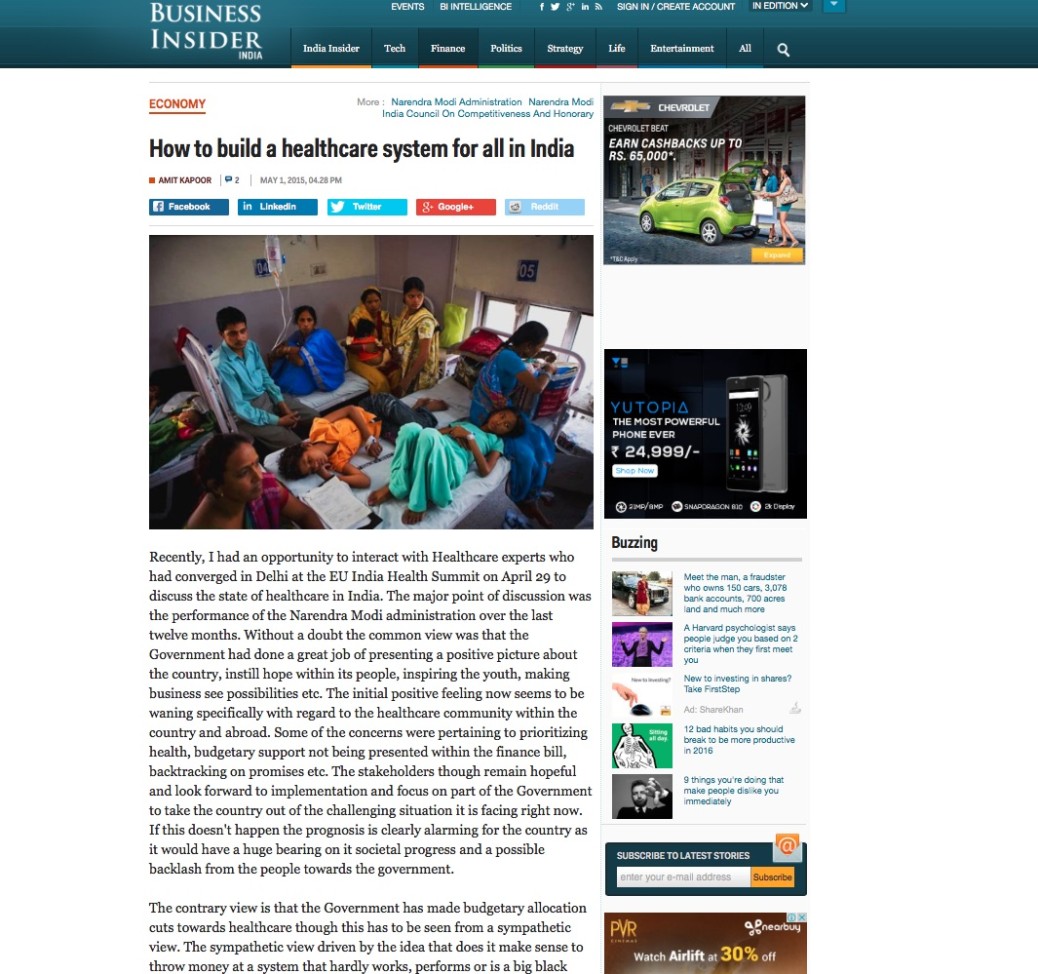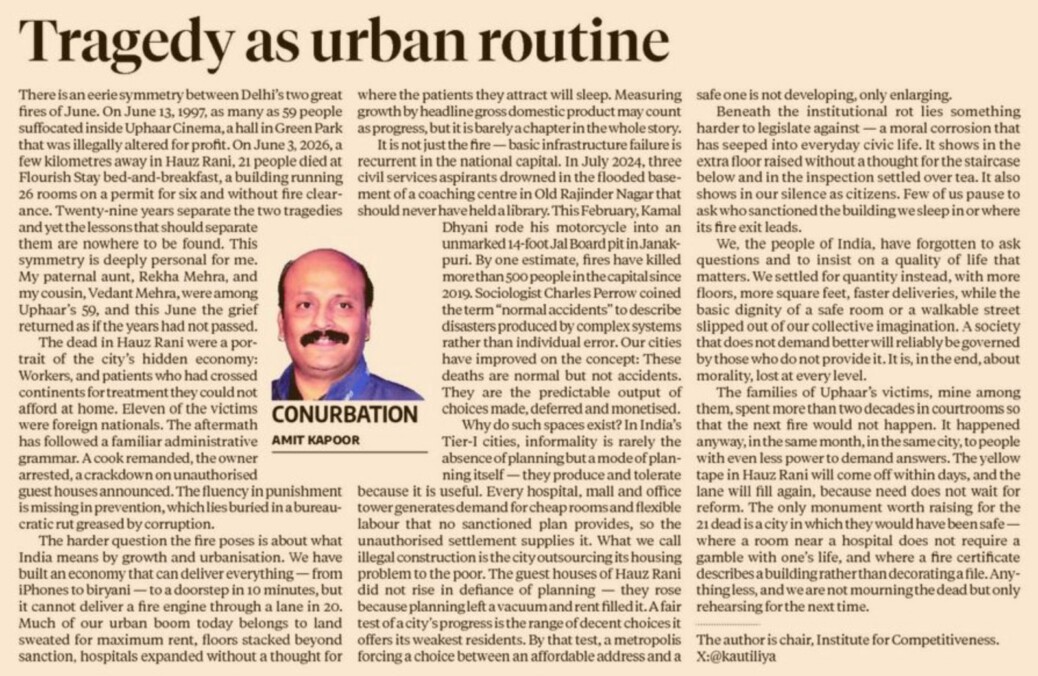
There is an eerie symmetry between Delhi’s two great fires of June. On June 13, 1997, fifty-nine people suffocated inside the Uphaar cinema in Green Park, in a hall altered illegally for profit. On June 3, 2026, a few kilometres away in Hauz Rani, twenty-one people died at the Flourish Stay bed and breakfast, a building running twenty-six rooms on a permit for six, without fire clearance. Twenty-nine years separate the two tragedies and yet the lessons that should separate them are nowhere to be found. This symmetry is also deeply personalfor me; my Bua, Rekha Mehra, and my cousin, Vedant Mehra, were among Uphaar’s fifty-nine, and this June the grief returned as if the years had not passed.
The dead in Hauz Rani were a portrait of the city’s hidden economy: workers, and patients who had crossed continents for treatment they could not afford at home. Eleven of the victims were foreign nationals. The aftermath has followed a familiar administrative grammar. A cook remanded, the owner arrested, a crackdown on unauthorised guest houses announced. The fluency in punishment is missing in prevention, which lies buried in a bureaucratic rut greased by corruption.
The harder question the fire poses is about what India means by growth and urbanisation. We have built an economy that can deliver everything ranging from iPhone and biryani to a doorstep in ten minutes but cannot deliver a fire engine through a lane in twenty. Much of our urban boom todaybelongs to the land sweated for maximum rent, floors stacked beyond sanction, hospitals expanded without a thought for where the patients they attract will sleep. Measuring growth by headline GDP counts all of it as progress but this is barely a figment in the whole story.
It is not just the fire, but basic infrastructure failure is recurrent in the capital. In July 2024, three civil services aspirants drowned in the flooded basement of a coaching centre in Old Rajinder Nagar that should never have held a library. This February, Kamal Dhyani rode his motorcycle into an unmarked fourteen-foot Jal Board pit in Janakpuri. By one estimate, fires alone have killed over five hundred people in the capital since 2019. Sociologist Charles Perrow coined “normal accidents” for disasters produced by complex systems rather than individual error. Our cities have improved on the concept: these deaths are normal, but not accidents. They are the predictable output of choices made, deferred, and monetised.
Why do such spaces exist? In India’s tier 1 cities, informality is rarely the absence of planning but a mode of planning itself, which they produce and tolerate because it is useful. Every hospital, mall, and office tower generates demand for cheap rooms, and flexible labour no sanctioned plan provides, so the unauthorised settlement supplies it. What we call illegal construction is the city outsourcing its housing problem to the poor. The guest houses of Hauz Rani did not rise in defiance of planning; they rose because planning left a vacuum and rent filled it. A fair test of a city’s progress is the range of decent choices it offers its weakest residents. By that test, a metropolis forcing a choice between an affordable address and a safe one is not developing, only enlarging.
Beneath the institutional rot lies something harder to legislate against, a moral corrosion that has seeped into everyday civic life. It shows in the extra floor raised without a thought for the staircase below and in the inspection settled over tea. It also reflects in our silence as citizens. Few of us pause to ask who sanctioned the building we sleep in or where its fire exit leads.
We, the people of India, have forgotten to ask questions, and to insist on a quality of life that matters. We settled for quantity instead with more floors, more square feet, faster deliveries, while the basic dignity of a safe room or a walkable street slipped out of our collective imagination. A society that does not demand better will reliably be governed by those who do not provide it. It is, in the end, about morality, lost at every level; is humanity itself dead?
The families of Uphaar’s victims, mine among them, spent more than two decades in courtrooms so that the next fire would not happen. It happened anyway, in the same month, in the same city, to people with even less power to demand answers. The yellow tape in Hauz Rani will come off within days, and the lane will fill again, because need does not wait for reform. The only monument worth raising to the twenty-one is a city in which they would have been safe where a room near a hospital does not require a gamble with one’s life, and where a fire certificate describes a building rather than decorating a file. Anything less, and we are not mourning the dead but only rehearsing for the next time.
(Amit Kapoor is chair, Institute for Competitiveness. X:@kautiliya).
The article was published with Business Standard on June 17, 2026.