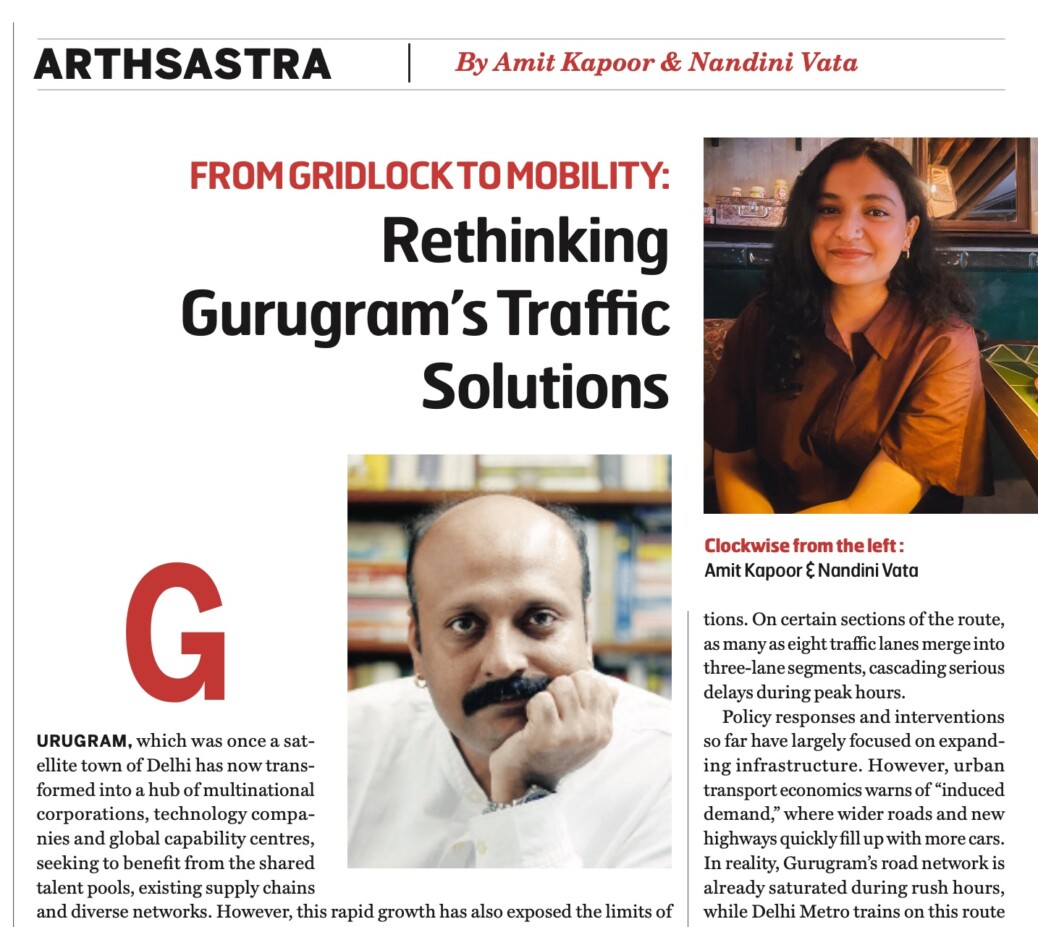
By Amit Kapoor and Nandini Vats
Gurugram, which was once a satellite town of Delhi has now transformed into a hub of multinational corporations, technology companies and global capability centres, seeking to benefit from the shared talent pools, existing supply chains and diverse networks. However, this rapid growth has also exposed the limits of unplanned urban expansion that is visibly manifested in the day-to-day congestions along the Delhi-Gurgaon expressway, i.e., NH-48, where economic productivity increasingly collides with severe mobility constraints. The extent of the problem is considerable and can be gauged from the fact that as per the Gurugram-Manesar Urban Complex (GMUC) plan, the population of the city is projected to reach 42.5 lakhs by the year 2031, driven by industrial expansion and increased residential developments.
Traffic gridlock in the city is not only about costs that extend beyond the individual’s experience of inconvenience; it is a fundamental economic burden to the structure of the economy itself, where congestion increases travel time, fuel consumption, and pollution while diminishing productivity through delays and unreliable commute durations, particularly in service-based urban economies where time lost in traffic equates into lost output. This gridlock has environmental, social, and psychological implications; coupled with deteriorating air quality, restricted family and leisure time, and turning daily commutes between Delhi and Gurugram into a persistent source of stress. In this sense, congestion is not only a transport-centric problem but rather a broader quality-of-life issue.
Various assessments have identified multiple operational bottlenecks along the route, these include abrupt lane contractions, poor road symmetry, lack of proper signage, encroached or non-functional bus stops, and violations of traffic regulations. On certain sections of the route, as many as eight traffic lanes merge into three-lane segments, cascading serious delays during peak hours.
Policy responses and interventions so far have largely focused on expanding infrastructure. However, Urban transport economics warns of “induced demand,” where wider roads and new highways quickly fill up with more cars. In reality, Gurugram’s road network is already saturated during rush hours, while Delhi Metro trains on this route frequently operate at full capacity.
While there are many possible measures that can be deployed to ‘treat’ congestion, there is no single perfect solution, since congestion mitigation is a cog in the wheel of the larger land use and urban planning process unique to each region. Therefore, near ideal solutions should take into consideration types of congestion, micro-drivers, economic and demographic situation amongst other factors. Further, we look at some of these solutions and their usage efficiency in the case at hand.
It is important to focus on long-term holistic solutions for congestion mitigation; roadway demand management tools which are a mix of access, parking and road-pricing measures offers one such plausible solution.
Rooted in the Pigouvian principle of internalising externalities, congestion pricing charges drivers for using crowded roads during peak hours, reflecting broader social, economic and environmental costs of delays as productivity loss, Greenhouse gas emissions and wasted fuel. Price-based access to roads in congested corridors encourages commuters to reconsider when and how they travel- whether by shifting to off-peak hours, car-pooling or using public transport. The core objective here is to reduce traffic volume, improve travel speed and allocate road space more efficiently by demand management. As noted in the Economic Survey 2025-26, international experiences, especially in London and Singapore illustrate the effectiveness of this system, where the Electronic Road Pricing (ERP) system in Singapore reduced private vehicle usage by 15% while generating around S$150 million annually. London’s congestion charging zones reduced traffic volumes by around 18% and increased the average travel speed by around 30% with about 80% of the revenue generated from this system reinvested in strengthening transport and pedestrian infrastructure. A similar pilot in the NH-48 Delhi-Gurgaon Expressway region supported by digital integration and real-time traffic monitoring could complement existing mobility initiatives. However, while congestion pricing also has significant shortcomings in terms of high equity concerns and disproportionate burdening of low-income drivers; ring-fencing revenues generated for transport improvements, protected cycle lanes and maintained footpaths, as well as subsidies for low-income commuters, can assist in keeping the system user-benefit centric and equitable.
Beyond congestion pricing, several complementary strategies can help decongest this route. One such approach is traffic operation and intersection management, where small operational changes like coordinated traffic signals, improved signage and regular monitoring of roadway performance can improve corridor efficiency. The aim here is to identify specific congestion hotspots along the route and address them through adjustments within the existing infrastructure without large-scale road expansion. A more policy-centric approach can be integrating transport planning within land-use policies which can be categorised as a long-term intervention.
International assessments shows that congestion is closely linked with how cities organise jobs, housing and commercial activity, establishing coordination through mixed-use development, transit-oriented planning and mobility plans can gradually reduce long distance commuting along high-traffic corridors. Another important factor at play is encouraging staggered work hours, corporate mobility and plans which can distribute travel time across an extended time window as balancing extreme travel-time variability rather than only average congestion can significantly help improve commuter experience.
The social dividends of such interventions would be significant with residents reclaiming precious time, less idling also means lower emissions, contributing to healthier air and the revenue such generated when redirected towards making the city more liveable translate to larger residual social gains that go beyond just reducing jams.
Ultimately, Demand management interventions are not a silver bullet, they work best as part of a multi-pronged approach that includes robust public transit, traffic enforcement and smart urban design, and behavioural incentives coupled with governance interventions. As Gurugram reaches the limits of what new roads and metros can solve, such policy interventions can offer a holistic way to manage demand which has become as important as expanding supply and in turn supporting the city’s economic dynamism.
The article was published with Business World on April 21, 2026.