By Amit Kapoor and Meenakshi Ajith
An Indian city’s cleanliness is decided afresh every morning, by sanitation workers on their beats, drivers on their collection routes and the supervisors who direct them. It is that daily work PRAGATI-50, launched on September 29 at the Prime Minister’s direction, now holds to a higher standard in 50 cities across 24 states, which must show “sustained, high-performance parameters of visible cleanliness”, tracked through KPIs, a PRAGATI-style digital review and meetings chaired by the Union Minister every other month. The push is welcome, and it asks the mission to turn a decade of building and campaigning into everyday practice, which cities can sustain only with capacities and institutions of their own.
When the Swachh Bharat mission began on Gandhi Jayanti in 2014, Indian cities processed 16 per cent of their waste. By the national review in May that share had risen to 81 per cent, door-to-door collection had reached 97 per cent of wards and 65 per cent of the waste in old dumpsites had been cleared. Most of this progress, like the toilets that made urban India open defecation free, came from what could be sanctioned, built and counted, carried along by a campaign that made swachhata a matter of civic pride and turned the Swachh Survekshan into a contest cities took seriously.
The Solid Waste Management Rules, 2026, in force since April, show how many hands a clean city passes through. Households are to separate waste four ways and bulk generators to process their own wet waste where they can, municipalities collect and transport it, state pollution control boards levy penalties, district collectors oversee landfills, the central board runs a national portal and a committee chaired by each state’s chief secretary is to steer implementation. These rules assume a level of coordination India’s waste governance has historically found difficult to sustain, and that enforcement falls mainly on generators, with no equivalent trigger when a city lacks the vehicles, staff or plants to keep segregated waste apart.
Used water passes through more hands still, with sewerage in larger cities falling under AMRUT and in towns of fewer than a lakh people under Swachh Bharat, which since 2021 has aimed to keep untreated wastewater out of water bodies. In many states the pipes and plants belong to water boards that answer to the state government rather than the city. The CAG’s audits of 393 urban local bodies in 18 states found that cities fully controlled only four of the 18 functions the 74th Amendment assigns them, with parastatals running five on average. They also found 37 per cent of sanctioned municipal posts vacant and local bodies in 16 states with limited or no power to recruit. Municipal revenues have hovered around 1 per cent of GDP for over a decade, a 2024 paper for the Prime Minister’s Economic Advisory Council noted. Grants can build a plant, but running it needs recurring revenue, and a 2025 study of three leading cities found no state charging cost-covering user fees and most residents unwilling to pay.
The mission’s guidelines for its second phase acknowledged in 2021 that the first had brought to light “qualitative and quantitative shortfalls in the capacities of the key personnel” and called for “a cadre of professionals” in cities and states. The capacity building framework that followed delivers support through programme units, contractual city managers and two-month internships and measures progress in trainings held, though it sensibly made the integration of informal workers, including those who clean sewers and septic tanks, a condition for releasing its funds. The new rules still offer little guidance on integrating waste pickers, who risk being displaced as segregation tightens and systems are mechanised.
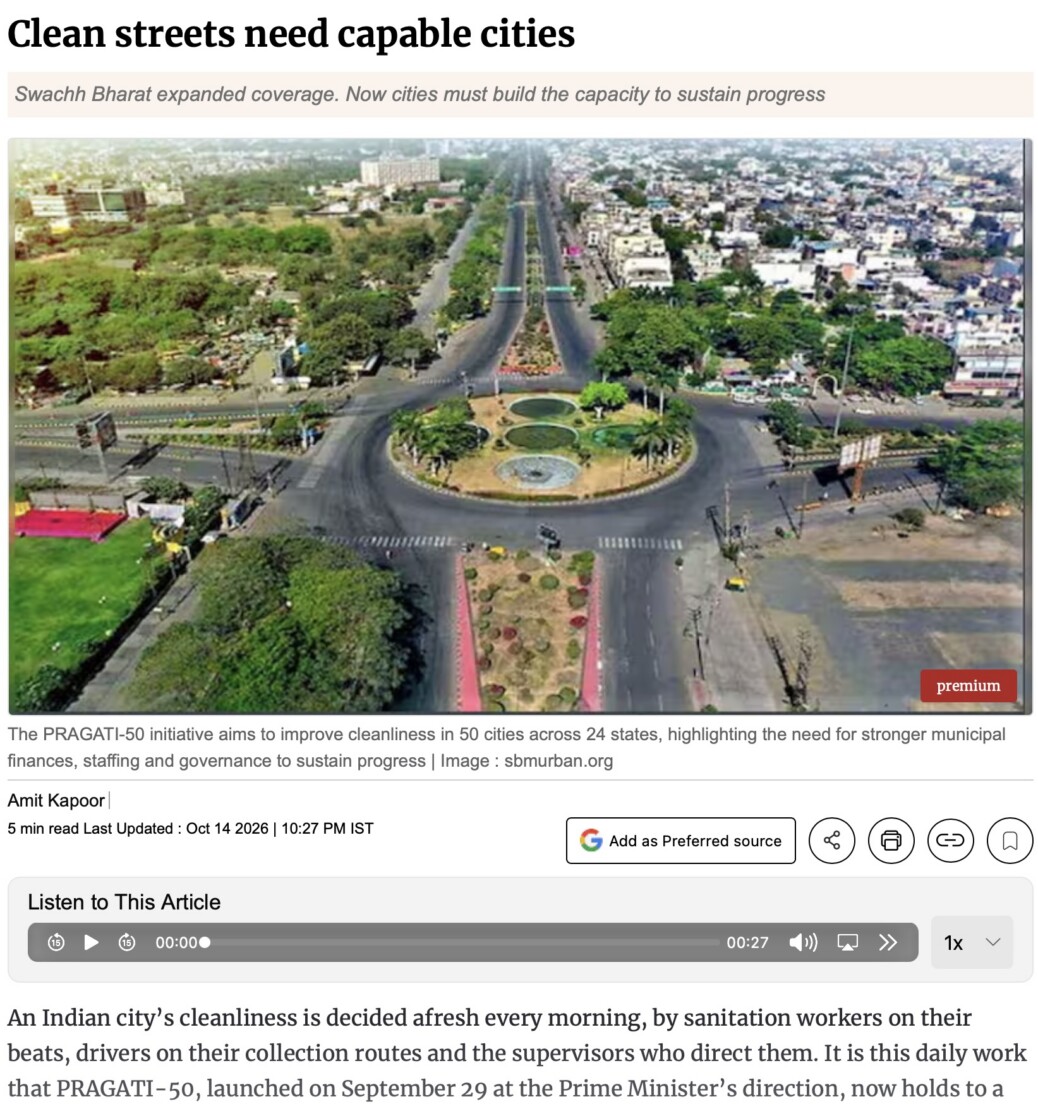
The 50 cities for PRAGATI initiative include major cities, cultural and tourist centres and economic hubs, chosen to serve as role models for the rest of the country. The towns expected to follow are smaller, and the 2025 study linked better results to the greater capacity of larger cities, observing that in a smaller city better habits can be prompt but short-lived. Financing the clean-up of legacy dumpsites will remain hard for towns with limited fiscal capacity. The Union minister’s reminder to states in May that “the strength of the chain lies in the weakest link of the chain” is a fair test for PRAGATI-50 itself.
The task ahead is to enhance recruitment powers, timely fiscal transfers, clear accountability for sewerage and regional bodies to plan shared facilities for small-town clusters. Once the cities are equipped with supportive institutions, fiscal space and technical capacity – a fair monitoring of the outcomes can track institutional measures alongside visible ones, such as vacancies filled, running costs recovered from user charges and sewage capacity actually used, checked against household surveys. Each model city could mentor smaller towns so that capability spreads with the results.
Change of this kind tends to arrive in two movements. Swachh Bharat’s first decade created awareness and added numbers, in toilets built, wards covered and waste processed, and it did so at remarkable speed. The movement now required is slower, turning new habits into settled practice, and it depends on cities with the people, money and authority to sustain them after the campaign has passed. That is capacity building in its fullest sense, and PRAGATI-50 can be where it begins.
The article was published with Business Standard on October 14, 2026.