By Amit Kapoor and Meenakshi Ajith
India stands at a rare historical moment when global supply chains are fragmenting, capital is seeking new homes, and a confluence of demographic scale, digital infrastructure, and geopolitical positioning has placed the country not merely as a participant in this reordering, but as one of its principal destinations. The current tensions between the United States and Iran are only the latest reminder that the global order is being contested, not merely reshuffled. Yet, such moments are weathered only by those nations who have done the harder work of building productive foundations. Every major rupture in global order, from trade wars and pandemics to energy conflicts, has delivered the same underlying verdict. Nations with deep productive foundations absorb shocks and emerge stronger. Those without find that each disruption exposes another structural weakness. The deeper contest, and the one that outlasts every ceasefire, is the contest of national competitiveness.
While India’s headline growth numbers have garnered impressive attention, it is also equally important to pay attention one more number. India’s real GDP per capita (constant 2015 USD) is $2397 in 2024. At the same time, Vietnam has crossed $4000, Indonesia sits at $4368 and Brazil at $9567. These numbers are not a cause of alarm yet, but they are a critical guidepost. A precise and honest indication of how much productive capacity India must build to convert this moment into lasting and shared prosperity.
Productivity is, at its simplest, the value an economy generates per unit of effort. It is not the same as growth. A country can grow rapidly by adding more workers to fields and factories while remaining fundamentally unproductive and generating less value per person than it should, and remaining perpetually vulnerable to the next shock. Competitiveness, as Michael Porter established, is built not on inherited endowments but on the ability to continuously upgrade the factors that drive economic output: skills, technology, institutions, and specialised knowledge. ‘National prosperity is created, not inherited’, and that distinction matters enormously for how India thinks about the next decade.
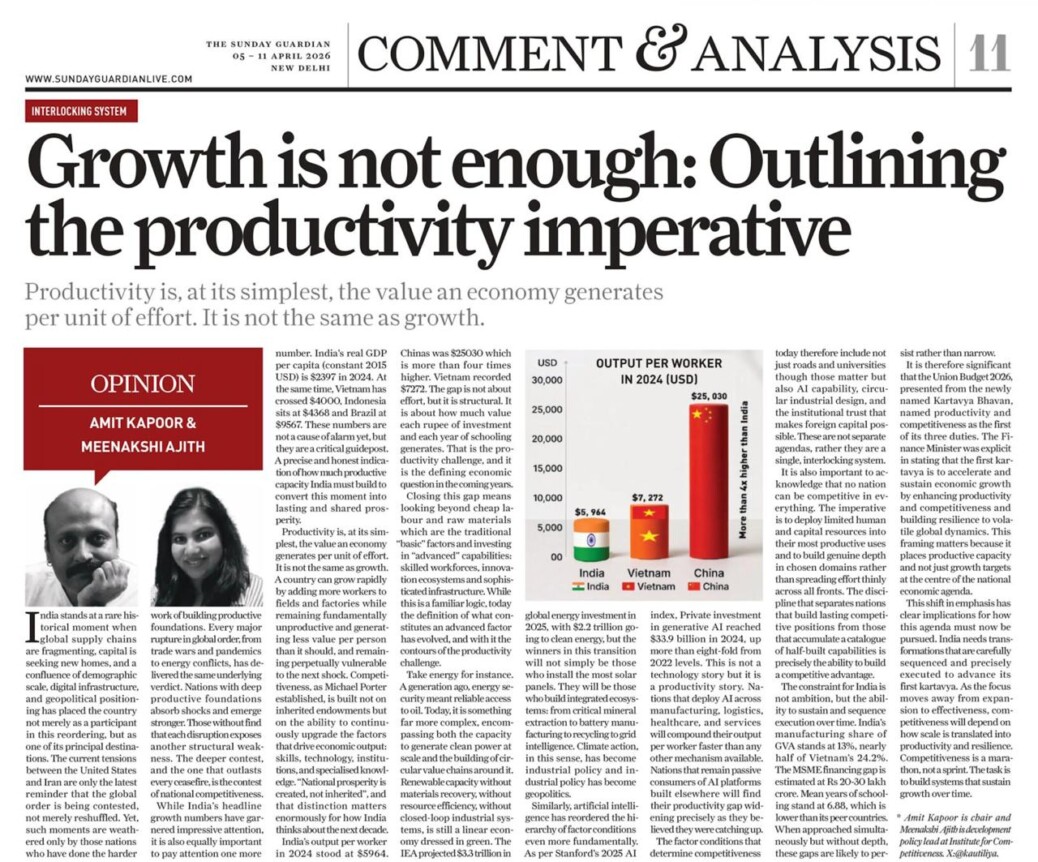
India’s output per worker in 2024 stood at $5964. Chinas was $25030 which is more than four times higher. Vietnam recorded $7272. The gap is not about effort, but it is structural. It is about how much value each rupee of investment and each year of schooling generates. That is the productivity challenge, and it is the defining economic question in the coming years.
Closing this gap means looking beyond cheap labour and raw materials which are the traditional “basic” factors and investing in “advanced” capabilities: skilled workforces, innovation ecosystems and sophisticated infrastructure. While this is a familiar logic, today the definition of what constitutes an advanced factor has evolved, and with it the contours of the productivity challenge.
Take Energy for instance. A generation ago, energy security meant reliable access to oil. Today, it is something far more complex, encompassing both the capacity to generate clean power at scale and the building of circular value chains around it. Renewable capacity without materials recovery, without resource efficiency, without closed-loop industrial systems, is still a linear economy dressed in green. The IEA projected $3.3 trillion in global energy investment in 2025, with $2.2 trillion going to clean energy but the winners in this transition will not simply be those who install the most solar panels. They will be those who build integrated ecosystems: from critical mineral extraction to battery manufacturing to recycling to grid intelligence. Climate action, in this sense, has become industrial policy and industrial policy has become geopolitics.
Similarly, Artificial intelligence has reordered the hierarchy of factor conditions even more fundamentally. As per Stanfords’ 2025 AI index, Private investment in generative AI reached $33.9 billion in 2024 up more than eight-fold from 2022 levels. This is not a technology story but it is a productivity story. Nations that deploy AI across manufacturing, logistics, healthcare, and services will compound their output per worker faster than any other mechanism available. Nations that remain passive consumers of AI platforms built elsewhere will find their productivity gap widening precisely as they believed they were catching up.
The factor conditions that determine competitiveness today therefore include not just roads and universities though those matter but also AI capability, circular industrial design, and the institutional trust that makes foreign capital possible. These are not separate agendas, rather they are a single, interlocking system.
It is also important to acknowledge that no nation can be competitive in everything. The imperative is to deploy limited human and capital resources into their most productive uses and to build genuine depth in chosen domains rather than spreading effort thinly across all fronts. The discipline that separates nations that build lasting competitive positions from those that accumulate a catalogue of half-built capabilities is precisely the ability to build a competitive advantage.
The constraint for India is not ambition, but the ability to sustain and sequence execution over time. India’s manufacturing share of GVA stands at 13 per cent nearly half of Vietnam’s 24.2 per cent. The MSME financing gap is estimated at Rs 20-30 lakh crore. Mean years of schooling stand at 6.88 which is lower than its peer countries. When approached simultaneously but without depth, these gaps are likely to persist rather than narrow.
It is therefore significant that the Union Budget 2026, presented from the newly named Kartavya Bhavan, named productivity and competitiveness as the first of its three duties. The Finance Minister was explicit in stating that the first kartavya is to accelerate and sustain economic growth by enhancing productivity and competitiveness and building resilience to volatile global dynamics. This framing matters because it places productive capacity and not just growth targets at the centre of the national economic agenda.
This shift in emphasis has clear implications for how this agenda must now be pursued. India needs transformations that are carefully sequenced and precisely executed to advance its first kartavya. As the focus moves away from expansion to effectiveness, competitiveness will depend on how scale is translated into productivity and resilience. Competitiveness is a marathon, not a sprint. The task is to build systems that sustain growth over time.
(Amit Kapoor is chair and Meenakshi Ajith is development policy lead at Institute for Competitiveness. X:@kautiliya).
The article was publsihed with