Mind the Capital gap: Beyond India’s AI summit moment
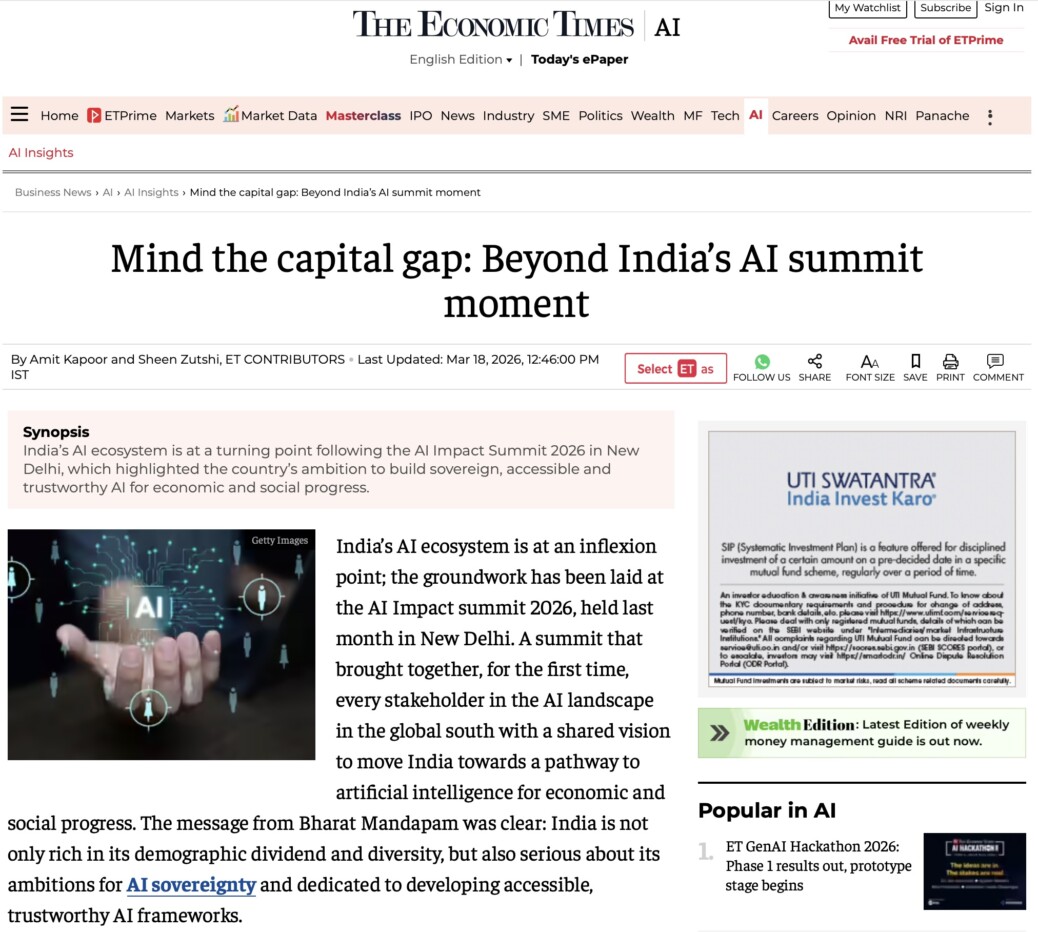
India’s AI ecosystem is at an inflexion point; the groundwork has been laid at the AI Impact summit 2026, held last month in New Delhi. A summit that brought together, for the first time, every stakeholder in the AI landscape in the global south with a shared vision to move India towards a pathway to artificial intelligence for economic and social progress. The message from Bharat Mandapam was clear: India is not only rich in its demographic dividend and diversity, but also serious about its ambitions for AI sovereignty and dedicated to developing accessible, trustworthy AI frameworks.
Over the next few years, to enhance its position in the AI landscape and achieve the vision set at the AI summit, India must pursue a different path to build its competitive advantage. In today’s global landscape, where surface-level AI applications can be easily copied and foundational models are becoming more accessible, India’s competitive advantage would lie in leveraging artificial intelligence to transform existing systems across sectors such as healthcare, climate intelligence, agriculture, and manufacturing.
India’s challenge lies in building such companies with defensible moats strong enough to attract long-term capital. A “defensible moat” in this context means barriers that competitors cannot easily replicate, such as proprietary data gathered over time, deep integration into key workflows, control over compute infrastructure, and regulatory positioning. This cannot happen without an ecosystem characterised by a lower early-stage risk appetite in its innovators, which have historically struggled to produce globally dominant firms. Funding this transition requires investors willing to absorb the associated risks. This shift demands a far greater risk appetite and long-term capital than what Indian Investors have so far demonstrated in the AI landscape.
Globally, AI Venture capital (VC) reveals a startling picture of this landscape. According to the OECD AI platform database, in 2025, AI-focused VC investment reached around $194 billion in the United States, $13.8 billion in China, and over $15 billion in the EU27. In India, VC investment was about $2.5 billion, roughly 1 per cent of the United States’ VC investment and only 18 per cent of China’s, highlighting a disparity and a challenge for the country to reflect upon. VC investment has also decreased from $5.7 billion in 2021. This dynamic has clear implications for the startup ecosystem in India because the capital gap is not solely driven by VC investment levels relative to other countries or by its scale. It almost ascertains that if domestic investors remain selective in their approach, sustained reliance on foreign capital will shape the next phase of the country’s AI landscape trajectory.
To bridge this VC gap, foreign companies are stepping up with their strategic investments. During the AI summit, NVIDIA announced its partnership with Activate Fund, a venture capital firm focused on AI and early-stage investments to discover and support the next generation of AI startups in India, bolstering the local innovation pipeline. This partnership extends beyond just any investment deal. Tobias Halloran, Director of EMEAI Startups and Venture Capital at NVIDIA, has said that this collaboration will go further by providing founders in India with direct access to technical training, GPUs, computing resources, and development support. At the same time, Anthropic’s Bengaluru presence has opened more possibilities for the company to embed itself in its second-largest global user base and within India’s AI talent base. Moreover, last November, it was announced that Google’s AI Futures Fund and Accel had partnered to co-invest up to $2 million in at least 10 early-stage Indian AI startups.
Clearly, there is more beneath the hype of large-scale compute and data centre commitments from global AI leaders if one examines carefully what unfolded at the AI summit in India. These companies are not only entering as market players in areas where they already have dominance but also signalling a dedication to strengthening AI infrastructure in India by offering capital, compute, and technical credibility at a time when domestic investors are prioritising short-term revenue and falling behind.
As Vinod Khosla, an early investor in OpenAI and a prominent Indian American billionaire and venture capitalist in Silicon Valley, signalled at the AI summit, “consensus in VC means you miss the outlier.” Given that the AI marketplace is driven by outliers and uncertainty, his message is clear that domestic investors need to wake up and sharpen their focus on AI. The downside is limited to invested capital, but the upside could be its exponential potential given the country’s diverse landscape.
India won’t close the gap by funding only safe, near-term enterprises that are already clones mastered around the world. Unfortunately, this has always been a challenge in India, and this approach needs to change. As the constraint no longer remains about idea generation, which is already being driven by Silicon Valley, it is about early-stage risk appetite. The winner would take it all, given that there are incentives to pursue high-risk, high-conversion bets in the market for everyone. However, the current ecosystem lacks sufficient early-stage capital and the willingness to absorb the uncertainty of this market to progress from promising use-case-based solutions to tackle hard, structural, complex issues faced by the country across education, healthcare, and last-mile delivery for its citizens.
Right now, only India’s ambition for a sovereign AI landscape is visible, and it was unveiled on the global stage during the summit. To achieve a global vision for AI that guarantees equitable distribution of its benefits across humanity, India must advance at the funding frontier, a costly yet essential endeavour.
Without leading the frontier of funding ambitious AI ventures in India, the country remains at risk of becoming a consumer and deployment market rather than having its own foundational Bob-the-Builder moment. The only remaining question is whether the AI India summit’s visibility can translate into capital from domestic investors and a sustained frontier risk appetite among its innovators and firms on a scale never seen before in the coming decade.
(Amit Kapoor is chair, and Sheen Zutshi is Research Manager, Institute for Competitiveness. X: @kautiliya).
The article was published with Economic Times on March 18, 2026.