By Amit Kapoor and inputs from Darshana Guaratra
The rise of Indo-Pacific: India-Japan’s next chapter
2026 might feel like a déjà vu. In 2007, Shinzo Abe drew from the 1655 text Majma-ul-Bahrain to quote the ‘Confluence of Two Seas’. Following on his footsteps, Japanese Prime Minister Takaichi Sanae endeavours to build a Free and Open Indo-Pacific with strategic ties with India. In 1952, India concluded a Peace Treaty with Japan marking the beginning of their diplomatic relations. The Indian judge on the International Military Tribunal for the Far East, Justice Radhabinod Pal, delivered a landmark judgement arguing for the acquittal of all accused. For Japan and India, even before the first MoU was signed, even before digital partnerships and semiconductor frameworks there was a partnership where both treated each other with dignity.
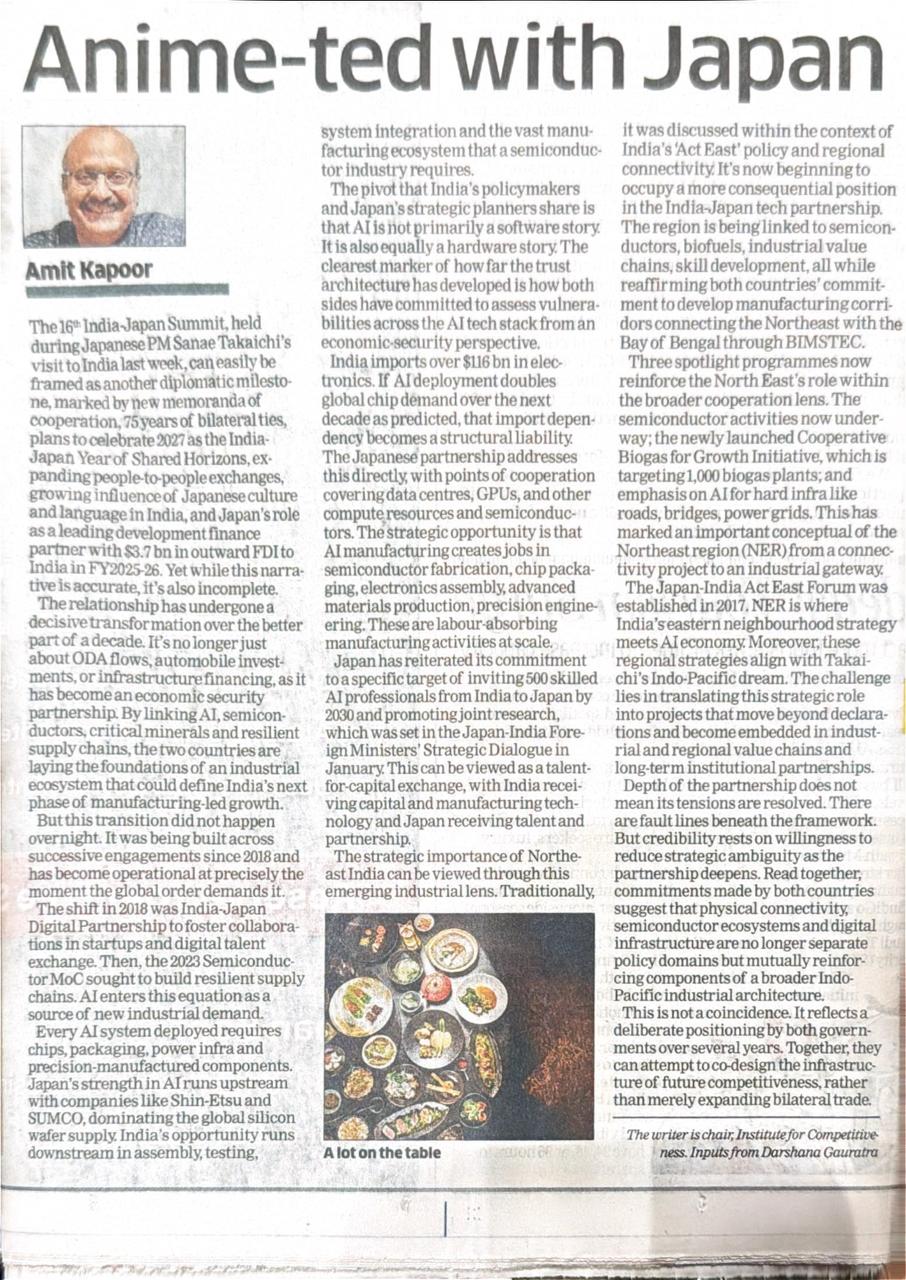
The easiest way to read the 16th India-Japan summit is to count the number of MoCs and call it a diplomatic milestone. This year marks the 75th year of diplomatic relations with plans to celebrate 2027 as the India-Japan Year of Shared Horizons. Over 540,000 people travelled between the two countries in 2025. A young generation of Indians has grown up on Japanese aesthetics ranging from anime to sushi. Japanese language is also expanding in India through the Nihongo Partners programme. The familial arc of Japan’s presence as one of India’s largest development finance partners is also the standard narrative. Japanese outward FDI to India in FY 2025-26 was $3.7 billion. The story here, however, is true but incomplete.
The India-Japan relationship has undergone a quiet but decisive transformation over the better part of a decade. It is no longer just about ODA flows, automobile investments or infrastructure financing as it has become an economic security partnership. Currently, India and Japan’s bilateral trade stands at $27.48 billion. By linking AI, semiconductors, critical minerals and resilient supply chains, the two countries are laying the foundations of an industrial ecosystem that could define India’s next phase of manufacturing-led growth. However, this transition did not happen overnight. It was slowly being built across successive engagements since 2018 and it has become operational at precisely the moment the global order demands it.
The shift in 2018 was the India-Japan Digital Partnership to foster collaborations in start-ups and digital talent exchange. Then the 2023 Semiconductor Memorandum of Cooperation sought to build resilient supply chains. AI enters this equation as a source of new industrial demand. Every AI system deployed requires chips, packaging, power infrastructure and precision-manufactured components. Japan’s strength in AI runs upstream with companies like Shin-Etsu and SUMCO dominating the global silicon wafer supply. India’s opportunity runs downstream in assembly, testing, system integration and the vast adjacent manufacturing ecosystem that a semi-conductor industry requires. The pivot that India’s policymakers and Japan’s strategic planners share is that AI is not primarily a software story. It is also equally a hardware story. The clearest maker of how far the trust architecture has developed is how both sides have committed jointly to assess the vulnerabilities across the AI technology stack from an economic-security perspective.
India currently imports over $116 billion in electronics. If AI deployment doubles global chip demand over the next decade as predicted, that import dependency becomes a structural liability. The Japanese partnership addresses this directly with points of cooperation covers data centres, GPU and other compute resources and semiconductors. This conversation has reversed the causality of AI and employment. The strategic opportunity is that AI manufacturing creates jobs in semiconductor fabrication, chip packaging, electronics assembly, advanced materials production, precision engineering. These are labour-absorbing manufacturing activities at scale.
Japan has reiterated its commitment to a specific target of inviting 500 highly skilled AI professionals from India to Japan by 2030 and promoting joint research which was set in Japan Foreign Ministers’ Strategic Dialogue in January 2026. This can be viewed as a talent-for capital exchange with India receiving capital and manufacturing technology and Japan receiving talent and partnership. The strategic importance of North-East India can be viewed through this emerging industrial lens. Japan’s investment in the North-East long began as development finance. Traditionally, it was discussed within the context of the Act East Policy and regionally connectivity. It is now beginning to occupy a more consequential position in the India-Japan technology partnership.
North-Eastern Region is now being linked to semiconductors, biofuels, industrial value chains, skill development all while reaffirming both countries commitment to develop manufacturing corridors connecting the North-East with the Bay of Bengal through BIMSTEC. Three spotlight programmes now reinforce North-East’s role within the broader cooperation lens. The semi-conductor activities which are underway, the newly launched Cooperative Biogas for Growth Initiative which is targeting 1,000 biogas plants and the emphasis on AI for hard infrastructure like roads, bridges, power grids. This has marked an important conceptual of the NER from a connectivity project to an industrial gateway. The Japan-India Act East Forum was established in 2017. NER is where India’s eastern neighbourhood strategy meets the AI economy. Moreover, these regional strategies directly align with Takaichi’s Indo-Pacific dream. The challenge lies in translating this strategic role into projects that move beyond declarations and become embedded in industrial and regional value chains and long-term institutional partnerships.
The depth of the partnership does not mean its tensions are resolved. There are fault lines beneath the framework but the credibility rests on willingness to reduce strategic ambiguity as the partnership deepens. Read together, the commitments made by both countries suggest that physical connectivity, semiconductor ecosystems and digital infrastructure are no longer separate policy domains but mutually reinforcing components of a broader Indo-Pacific industrial architecture. This is not a coincidence, it reflects a deliberate positioning by both governments over several years. Together, they can attempt to co-design the infrastructure of future competitiveness rather than merely expanding bilateral trade.
The article was published with Economic Times on July 6, 2026.