What Actually Moves Farmer Income?
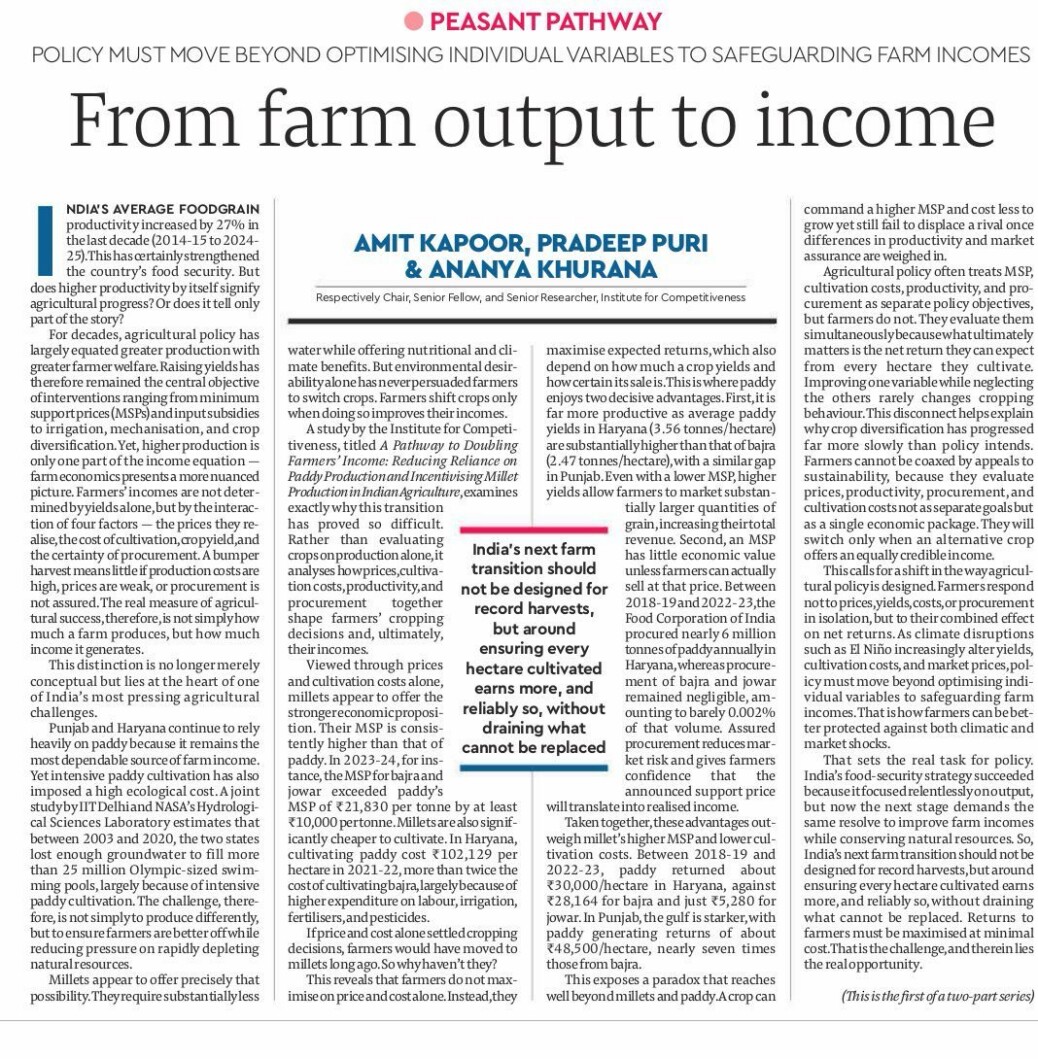
India’s average foodgrain productivity increased by 27% over the last decade, from 2014–15 to 2024–25. This has certainly strengthened the country’s food security. But does higher productivity, by itself, signify agricultural progress? Or does it tell only part of the story?
For decades, agricultural policy has largely equated greater production with greater farmer welfare. Raising yields has therefore remained the central objective of interventions ranging from minimum support prices (MSP) and input subsidies to irrigation, mechanisation and crop diversification. Yet higher production is only one part of the income equation. Farm economics, however, presents a more nuanced picture. Farmers’ incomes are not determined by yields alone, but by the interaction of four factors: the prices they realise, the cost of cultivation, crop yield and the certainty of procurement. A bumper harvest means little if production costs are high, prices are weak or procurement is not assured. The real measure of agricultural success, therefore, is not simply how much a farm produces, but how much income it generates.
This distinction is no longer merely conceptual but lies at the heart of one of India’s most pressing agricultural challenges.
Punjab and Haryana continue to rely heavily on paddy because it remains the most dependable source of farm income. Yet intensive paddy cultivation has also imposed a high ecological cost. A joint study by IIT Delhi and NASA’s Hydrological Sciences Laboratory estimates that between 2003 and 2020, the two states lost enough groundwater to fill more than 25 million Olympic-sized swimming pools, largely because of intensive paddy cultivation. The challenge, therefore, is not simply to produce differently, but to make farmers better off while reducing pressure on rapidly depleting natural resources.
Millets appear to offer precisely that possibility. They require substantially less water while offering nutritional and climate benefits. But environmental desirability alone has never persuaded farmers to switch crops. Farmers shift crops only when doing so improves their incomes.
A study by the Institute for Competitiveness, titled A Pathway to Doubling Farmers’ Income: Reducing Reliance on Paddy Production and Incentivising Millet Production in Indian Agriculture, examines exactly why this transition has proved so difficult. Rather than evaluating crops on production alone, it analyses how prices, cultivation costs, productivity and procurement together shape farmers’ cropping decisions and ultimately, their incomes.
Viewed through prices and cultivation costs alone, millets appear to offer the stronger economic proposition. Their MSP is consistently higher than that of paddy. In 2023–24, for instance, the MSP for bajra and jowar exceeded paddy’s MSP of ₹21,830 per tonne by at least ₹10,000 per tonne. Millets are also significantly cheaper to cultivate. In Haryana, cultivating paddy cost ₹102,129 per hectare in 2021–22, more than twice the cost of cultivating bajra, largely because of higher expenditure on labour, irrigation, fertilisers and pesticides.
If price and cost alone settled cropping decisions, farmers would have moved to millets long ago. So why haven’t they?
This reveals that farmers do not maximise on price and cost alone. Instead, they maximise expected returns, which also depend on how much a crop yields and how certain its sale is. This is where paddy enjoys two decisive advantages. First, it is far more productive as average paddy yields in Haryana (3.56 tonnes/hectare) are substantially higher than that of bajra (2.47 tonnes/hectare), with a similar gap in Punjab. Even with a lower MSP, higher yields allow farmers to market substantially larger quantities of grain, increasing their total revenue. Second, an MSP has little economic value unless farmers can actually sell at that price. Between 2018–19 and 2022–23, the Food Corporation of India procured nearly 6 million tonnes of paddy annually in Haryana, whereas procurement of bajra and jowar remained negligible, amounting to barely 0.002% of that volume. Assured procurement reduces market risk and gives farmers confidence that the announced support price will translate into realised income.
Taken together, these advantages outweigh millet’s higher MSP and lower cultivation costs. Between 2018–19 and 2022–23, paddy returned about ₹30,000/hectare in Haryana, against ₹28,164 for bajra and just ₹5,280 for jowar. In Punjab, the gulf is starker, with paddy generating returns of about ₹48,500/hectare, nearly seven times those from bajra.
This exposes a paradox that reaches well beyond millets and paddy. A crop can command a higher MSP and cost less to grow yet still fail to displace a rival, once differences in productivity and market assurance are weighed in.
Agricultural policy often treats MSP, cultivation costs, productivity and procurement as separate policy objectives, but farmers do not. They evaluate them simultaneously because what ultimately matters are the net return they can expect from every hectare they cultivate. Improving one variable while neglecting the others rarely changes cropping behaviour. This disconnect helps explain why crop diversification has progressed far more slowly than policy intends. Farmers cannot be coaxed by appeals to sustainability, because they evaluate prices, productivity, procurement and cultivation costs not as separate goals but as a single economic package. They will switch only when an alternative crop offers an equally credible income.
This calls for a shift in the way agricultural policy is designed. Farmers respond not to prices, yields, costs or procurement in isolation, but to their combined effect on net returns. As climate disruptions such as El Niño increasingly alter yields, cultivation costs and market prices, policy must move beyond optimising individual variables to safeguarding farm incomes. That is how farmers can be better protected against both climatic and market shocks.
That sets the real task for policy. India’s food-security strategy succeeded because it focused relentlessly on output, but now the next stage demands the same resolve to improve farm incomes while conserving natural resources. So, India’s next farm transition should not be designed for record harvests. It should be designed so that every hectare cultivated earns more, earns it more reliably, and does so without draining what cannot be replaced, maximising returns to farmers at minimal cost. That is the real challenge, and the real opportunity.
(Amit Kapoor is chair & Ananya Khurana, Senior Researcher at the Institute for Competitiveness. X: @kautiliya).
The article was published with Financial Express on July 3, 2026.